Details
How a Bridal Accessories Business Simplified Product Inquiries and Custom Orders
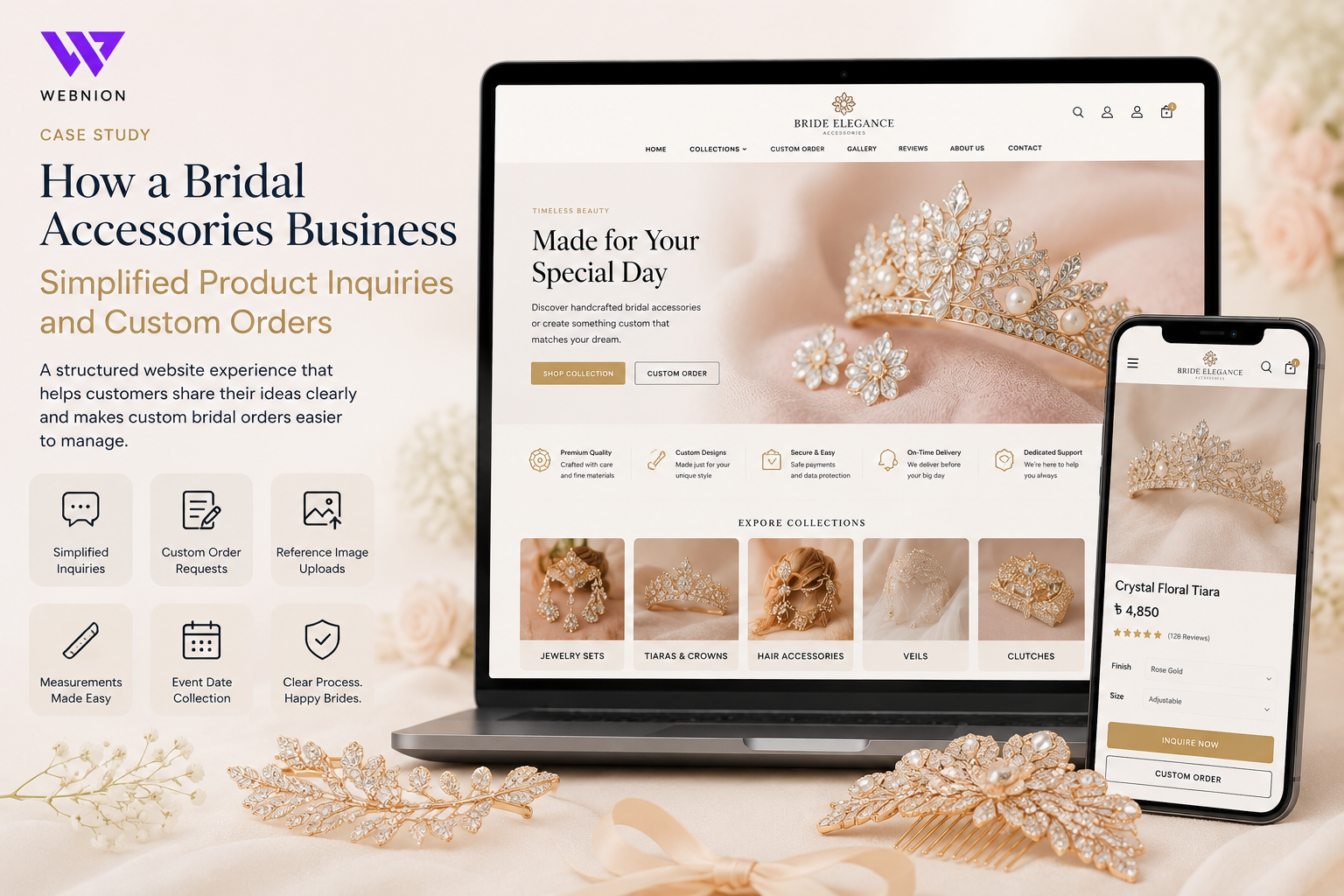
How a Bridal Accessories Business Simplified Product Inquiries and Custom Orders

1. Project Overview
A growing bridal accessories business needed a professional website that could showcase its collections, answer common product questions, and make custom-order requests easier to manage.
The business offered bridal jewelry, hair accessories, veils, crowns, tiaras, clutches, belts, decorative pieces, and other wedding accessories. Many products were available in different colors, materials, sizes, and design styles.
Some customers wanted ready-made items, while others required customized products that matched a specific dress, wedding theme, measurement, or event date.
Managing every inquiry manually through Facebook, Instagram, Messenger, and WhatsApp created repeated work. Important details were often scattered across long conversations, making it difficult to confirm exactly what the customer wanted.
Webnion planned a responsive bridal accessories website that combined premium product presentation, structured inquiries, customization requests, customer proof, and clear communication.
The goal was to help customers explore products confidently while giving the business a more organized way to manage custom orders.
2. The Business Challenge
Bridal customers usually require more information than ordinary online shoppers.
Before ordering, they may want to know:
- Whether the product matches their bridal outfit
- Which colors and finishes are available
- Whether the size can be adjusted
- What materials are used
- Whether a design can be customized
- How long production will take
- Whether urgent delivery is possible
- What information is required for customization
- How much advance payment is needed
- Whether the final design can be reviewed before production
The business faced several common challenges:
- Product inquiries arrived through multiple platforms
- Customers often sent incomplete customization details
- Reference images became difficult to track
- Delivery dates were not always recorded clearly
- Staff repeatedly answered the same questions
- Ready-made and custom products followed different processes
- Pricing depended on materials and customization
- Customers needed stronger proof before paying an advance
- Mobile visitors struggled to understand product options
- Order discussions could become long and confusing
The business needed one structured platform that could guide customers and organize the information required for each order.
3. Project Objectives
The project was planned around the following objectives:
- Present bridal accessories professionally
- Organize products into clear collections
- Simplify product inquiries
- Create a structured custom-order request process
- Collect measurements and preferences accurately
- Support reference-image uploads
- Communicate production time clearly
- Present advance-payment requirements
- Build trust through reviews and real work
- Improve mobile product discovery
- Reduce repetitive customer questions
- Prepare the business for future growth
Every part of the website was designed to support both customer confidence and operational clarity.
4. Our Strategy
We planned separate journeys for ready-made products and customized products.
The ready-made product journey was:
Discover the collection → Open a product → Review details → Select available options → Ask a question or place an order
The custom-order journey was:
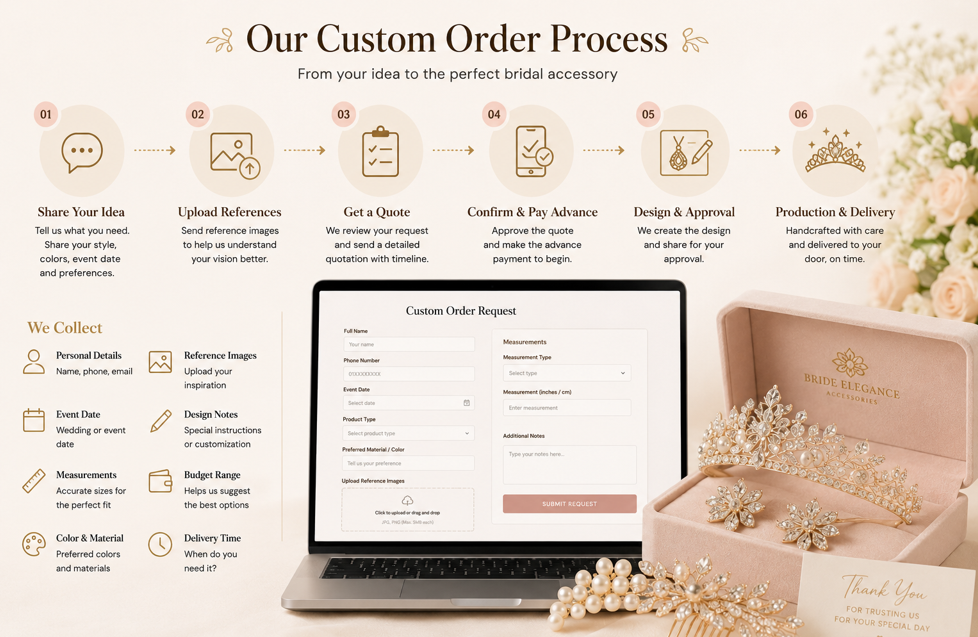
Choose a product type → Share design preferences → Submit measurements and reference images → Confirm event date → Receive quotation → Approve the order → Pay the required advance
Separating these journeys helped customers understand what information was required.
It also reduced the risk of incomplete custom-order requests reaching the business.
5. Organizing Bridal Accessory Collections
The website could organize products into collections such as:
- Bridal jewelry
- Tiaras and crowns
- Hair accessories
- Veils
- Bridal belts
- Clutches and handbags
- Couple accessories
- Bridesmaid accessories
- Wedding gift items
- Traditional bridal pieces
- Premium collections
- Customized designs
Customers could also browse according to:
- Wedding event
- Product color
- Design style
- Material
- Price range
- Ready-made availability
- Custom-order availability
This structure helped visitors reach relevant products without browsing an unorganized catalog.
6. Premium Product Presentation
Bridal accessories require detailed visual presentation.
Customers want to understand the finishing, scale, color, texture, and overall appearance before ordering.
The product experience could include:
- Front product image
- Side and back views
- Close-up craftsmanship
- Product worn by a model
- Size comparison
- Material details
- Available colors
- Packaging presentation
- Short product videos
- Real customer photos
Consistent photography helped the catalog feel more professional and made product comparison easier.
Model and lifestyle images also helped customers imagine how an accessory might look with a complete bridal outfit.
7. Clear Product Information
Each product page was structured to answer important questions before the customer contacted the business.
Product information could include:
- Product name
- Product category
- Material
- Color or finish
- Dimensions
- Weight where relevant
- Adjustable features
- Package contents
- Current price
- Customization availability
- Estimated preparation time
- Delivery information
- Care instructions
This reduced repetitive conversations and allowed customers to begin inquiries with greater clarity.
8. Product Variations
Bridal accessories may be available in multiple options, including:
- Gold, silver, rose gold, or antique finish
- White, ivory, red, maroon, or custom colors
- Different sizes
- Stone colors
- Chain lengths
- Veil lengths
- Hair-comb styles
- Packaging options
- Matching sets
Each variation could maintain its own:
- Price
- Stock
- SKU
- Product image
- Availability
- Preparation time
Customers could select available options before opening an inquiry or placing an order.
This helped the business understand the exact product combination being requested.
9. Simplified Product Inquiry Process
A generic contact form was not enough for bridal product inquiries.
The website could provide a focused inquiry action directly on each product page.
The inquiry could automatically include:
- Product name
- Product link
- Selected color
- Selected size
- Selected variation
- Customer name
- Phone number
- Required date
- Question or request
This eliminated the need for customers to manually copy product names or send unclear screenshots.
It also helped the sales team identify the relevant product immediately.
10. Structured Custom-Order Form
Custom bridal accessories require specific information.
A structured request form could collect:
- Customer name
- Phone number
- Email address
- Product type
- Preferred design
- Color preference
- Material preference
- Measurements
- Quantity
- Budget range
- Wedding or event date
- Required delivery date
- Reference images
- Additional instructions
Collecting these details at the beginning reduced unnecessary back-and-forth communication.
It also created a clearer project brief for the design and production team.
11. Reference Image Upload
Customers often find inspiration from social media, bridal magazines, or previous designs.
The custom-order process could allow them to upload:
- Dress images
- Existing accessory references
- Color references
- Jewelry inspiration
- Bridal theme images
- Sketches
- Measurement photos
Reference images helped the business understand the customer’s expectations more accurately.
The website also clarified that a reference image represented inspiration and that the final product could vary depending on material, production method, and customization requirements.
This helped manage expectations before production began.
12. Measurement Guidance
Some bridal accessories require accurate measurements.
The website could provide guidance for:
- Necklace length
- Wrist size
- Ring size
- Waist measurement
- Head circumference
- Veil length
- Hair-accessory placement
- Custom belt size
Visual diagrams and step-by-step instructions helped customers measure more accurately at home.
The form could also ask whether the customer required assistance with measurements.
Clear guidance reduced mistakes that could affect the final product.
13. Event Date and Production Timeline
Custom bridal products are often connected to fixed event dates.
The website needed to collect the wedding or event date before confirming the order.
The process could communicate:
- Standard production time
- Design-confirmation time
- Material-sourcing time
- Delivery time
- Urgent-order availability
- Additional urgent-order charges
- Final order deadline
Customers were encouraged to place custom orders early enough to allow for design approval, production, adjustment, and delivery.
This helped prevent unrealistic delivery expectations.
14. Quotation and Price Confirmation
Custom-product pricing can depend on:
- Design complexity
- Material
- Size
- Quantity
- Stones or decorative elements
- Personalization
- Packaging
- Production time
- Urgent delivery
The website therefore avoided presenting every custom product as having one fixed price.
After reviewing the customer’s request, the business could provide a quotation containing:
- Product description
- Selected customization
- Material
- Quantity
- Estimated production time
- Product price
- Delivery charge
- Advance payment
- Remaining balance
- Quotation validity
This gave customers a clearer understanding of the complete cost before confirming the order.
15. Advance Payment Process
Custom bridal products often require an advance payment before production begins.
The website could clearly explain:
- Required advance percentage or amount
- Accepted payment methods
- When production begins
- Whether the advance is refundable
- Conditions for cancellation
- Remaining payment deadline
- Payment-verification process
The customer could receive a payment confirmation after the advance was verified.
Transparent payment terms helped prevent misunderstandings and protected both the customer and the business.
16. Design Approval Workflow
Custom orders may require approval before production.
The process could follow these stages:
Request submitted → Requirements reviewed → Quotation sent → Advance payment received → Design preview shared → Customer approval received → Production begins
Where appropriate, the business could share:
- Sketch
- Digital preview
- Material sample
- Color reference
- Product layout
- Personalization details
The website and communication process clarified how many revisions were included.
Production started only after the customer approved the agreed design.
17. Custom-Order Status Tracking
Customers may contact the business repeatedly to ask whether their product is ready.
A structured order workflow could use statuses such as:
- Inquiry received
- Requirements under review
- Quotation sent
- Waiting for advance
- Design preparation
- Waiting for approval
- In production
- Quality check
- Ready for dispatch
- Shipped
- Delivered
Status updates helped customers understand progress without repeatedly requesting manual confirmation.
They also gave the team a clearer view of every active custom order.
18. WhatsApp-Assisted Communication
WhatsApp remained useful for discussing custom details.
The website connected structured product information with WhatsApp communication.
A prepared message could include:
Hello, I would like to inquire about this bridal accessory.
Product: Crystal Bridal Tiara
Selected Finish: Rose Gold
Required Date: 15 December
Product Link: [product page]
Please confirm customization options and preparation time.
This helped conversations begin with useful context.
The website collected essential information, while WhatsApp supported consultation and final confirmation.
19. Customer Reviews and Real Bridal Proof
Bridal customers want to see genuine results before trusting a business with an important event.
The website could present:
- Customer reviews
- Bridal photos
- Product close-ups
- Unboxing images
- Custom-order results
- Social media feedback
- Video testimonials
- Wedding-day photos
- Verified purchase indicators
Proof could be organized by product or collection.
For example, a custom tiara page could display reviews and images from customers who ordered similar designs.
This made social proof more relevant and persuasive.
20. Before-and-After Customization Examples
Custom-order galleries could show how an idea became a finished product.
The gallery might include:
- Customer reference image
- Initial design direction
- Material selection
- Production preview
- Final product
- Bridal styling result
This helped potential customers understand the business’s customization process.
It also demonstrated craftsmanship without relying only on promotional claims.
Customer permission should be obtained before publishing personal images or private conversations.
21. Bridal Consultation Booking
Some customers require more guidance before choosing accessories.
The website could offer a consultation request for:
- Complete bridal styling
- Jewelry and accessory matching
- Custom design planning
- Color coordination
- Bridal party accessories
- Bulk or family orders
The consultation form could collect:
- Event date
- Dress color
- Wedding theme
- Required products
- Budget
- Preferred consultation time
- Contact information
This helped the business prioritize serious inquiries and prepare before the conversation.
22. Mobile-Friendly Inquiry Experience
Most bridal customers discover products through Instagram, Facebook, Pinterest, TikTok, Messenger, and WhatsApp.
The website was therefore designed around mobile use.
Mobile visitors could:
- Browse collections
- View product images
- Zoom into details
- Select variations
- Read materials and measurements
- Review custom-order options
- Upload reference images
- Submit an inquiry
- Open WhatsApp
- Review customer proof
Forms, buttons, selectors, and image uploads were designed to remain comfortable on smaller screens.
The goal was to make detailed bridal inquiries possible without requiring a desktop computer.
23. Search and Filtering
Customers could narrow the catalog using filters such as:
- Product type
- Collection
- Color
- Material
- Occasion
- Price range
- Ready-made products
- Customizable products
- New arrivals
- Best sellers
- Availability
This helped customers find products that matched their wedding style and budget more quickly.
Better filters also improved inquiry quality because customers reached the business with clearer preferences.
24. Product Recommendations
Relevant recommendations could help customers create a coordinated bridal look.
The website could suggest:
- Matching earrings
- Coordinated necklace
- Bridal hairpiece
- Veil accessory
- Matching clutch
- Bridesmaid accessory
- Couple set
- Gift packaging
Recommendations were based on style, color, material, or collection.
The goal was to support complete styling rather than showing unrelated products.
25. Bridal Accessory Bundles
The business could create coordinated bundles such as:
- Bridal jewelry set
- Tiara and earrings
- Veil and hair accessory
- Necklace, earrings, and bracelet
- Bride and bridesmaid set
- Wedding gift bundle
Each bundle could explain:
- Products included
- Color and material
- Individual product value
- Bundle price
- Customization options
- Preparation time
- Availability
Clear bundle presentation helped customers understand the total offer and reduced the need to select every item separately.
26. Return and Exchange Information
Ready-made and custom products may require different policies.
The website could clearly explain:
- Return eligibility
- Exchange conditions
- Size-related exchange rules
- Damaged-product reporting time
- Custom-product restrictions
- Personalized-product restrictions
- Required product condition
- Processing time
- Customer-support process
Customized products may be non-returnable after approval and production begins.
This needed to be communicated before the advance payment was collected.
Transparent policies reduced disputes and protected customer trust.
27. Delivery and Packaging
Bridal products require careful handling and premium presentation.
The website could explain:
- Protective packaging
- Premium bridal box
- Product pouch
- Tamper-resistant delivery
- Delivery coverage
- Estimated shipping time
- Tracking availability
- Urgent-delivery conditions
- Damaged-package reporting
Packaging images helped customers understand how the product would arrive.
Premium packaging also increased value for gift and wedding purchases.
28. Admin and Order Management
The business needed a clearer internal process for managing inquiries and custom orders.
The administration system could organize:
- New inquiries
- Product requests
- Custom-order details
- Customer measurements
- Reference images
- Quotations
- Advance payments
- Approval status
- Production deadlines
- Delivery dates
- Order notes
- Assigned staff member
This reduced the risk of important information being lost inside personal message threads.
It also gave management a clearer view of pending work.
29. Staff Roles and Responsibilities
Different team members could manage different stages of the order.
Roles might include:
- Sales consultant
- Designer
- Production team
- Quality-control staff
- Accounts staff
- Packaging team
- Delivery coordinator
- Administrator
Each person could access the information relevant to their responsibilities.
This created clearer accountability and reduced internal confusion.
30. Customer Data and Inquiry History
A centralized customer record could include:
- Customer name
- Phone number
- Email address
- Product inquiries
- Custom-order history
- Measurements
- Reference images
- Quotations
- Payments
- Delivery details
- Notes
This helped the business serve repeat customers more effectively.
It also prevented customers from having to explain the same preferences again during future orders.
Sensitive customer information needed to be protected and accessed only by authorized staff.
31. Design Approach
The visual direction focused on bridal elegance, clarity, trust, and personalized service.
The design system included:
- Clean light backgrounds
- Refined typography
- Premium product photography
- Soft bridal color accents
- Consistent collection cards
- Clear inquiry buttons
- Structured customization sections
- Comfortable spacing
- Responsive forms
- Trust-focused proof areas
The website felt elegant without making product information difficult to find.
The design supported both emotional inspiration and practical decision-making.
32. Key Features Delivered
The bridal accessories solution included:
- Responsive e-commerce website design
- Organized bridal collections
- Premium product galleries
- Product videos
- Material and dimension information
- Product variations
- Ready-made product ordering
- Product-specific inquiry forms
- Structured custom-order requests
- Reference-image uploads
- Measurement guidance
- Event-date collection
- Quotation workflow
- Advance-payment information
- Design approval process
- Custom-order status tracking
- WhatsApp-assisted communication
- Bridal consultation requests
- Customer reviews and real proof
- Before-and-after customization galleries
- Bridal bundles
- Mobile search and filters
- Return and exchange policies
- Admin inquiry management
- Customer-order history
- Scalable product and order structure
Each feature was selected to simplify customer communication and create a more reliable custom-order process.
33. The Outcome
The completed solution created a clearer journey for customers purchasing ready-made bridal accessories or requesting customized designs.
Visitors could explore collections, review product information, select available options, submit measurements, upload references, and begin structured inquiries from one website.
The business gained a more organized method for reviewing requests, preparing quotations, collecting advance payments, managing approvals, and tracking production.
No unverified sales, conversion, or inquiry-growth percentages are being claimed. However, the platform directly addressed several operational and communication problems common in custom bridal businesses.
34. Business Value Created
The website helps the bridal accessories business:
- Present products professionally
- Simplify customer inquiries
- Collect complete customization details
- Reduce repetitive questions
- Organize reference images
- Record event and delivery dates
- Manage quotations more clearly
- Communicate advance-payment terms
- Reduce custom-order mistakes
- Improve design approval
- Track production progress
- Build trust through real bridal proof
- Support mobile customers
- Manage future growth more confidently
The project demonstrates that custom-order businesses need more than an attractive product gallery.
They need a system that turns customer ideas into organized, actionable order information.
35. Why This Project Matters
Bridal accessories are connected to important and time-sensitive events.
Customers need confidence that the product will match their expectations and arrive before the required date.
Businesses also need complete information before committing to a design, price, or delivery timeline.
A structured bridal website connects:
- Product inspiration
- Detailed information
- Customer measurements
- Reference images
- Quotation
- Advance payment
- Design approval
- Production tracking
- Delivery
This transforms scattered conversations into a more dependable custom-order process.
The website becomes both a premium digital showroom and a practical order-management tool.
36. Frequently Asked Questions
Can customers order ready-made bridal accessories through the website?
Yes. Ready-made products can include available variations, prices, stock information, and direct purchasing actions.
Can customers request a customized design?
Yes. A structured form can collect product type, design preferences, measurements, budget, event date, and reference images.
Can customers upload photos with their request?
Yes. Customers can upload dress images, inspiration photos, sketches, or other references relevant to the custom order.
Can the website collect measurements?
Yes. The form can collect required measurements and provide visual instructions for taking them correctly.
Can custom-product pricing be fixed on the website?
Some products may have fixed prices, but complex custom work may require a quotation based on materials, design, size, and production time.
Can the business collect an advance payment?
Yes. Custom orders can require partial or full advance payment before design or production begins.
Can customers approve a design before production?
Yes. The workflow can include a design preview and customer approval before production starts.
Can customers track custom-order progress?
Yes. Orders can use statuses such as design preparation, waiting for approval, production, quality check, and dispatch.
Can the system support urgent bridal orders?
Yes, when the business allows it. Urgent availability, additional charges, and realistic deadlines should be confirmed before accepting the order.
Is the website optimized for mobile users?
Yes. Product browsing, forms, file uploads, inquiries, and WhatsApp communication can be optimized for smartphones.
37. Need a Website for Your Bridal Accessories Business?
A bridal website should do more than display beautiful products.
It should help customers understand their options, share customization requirements, and move through the order process with confidence.
Webnion designs and develops responsive e-commerce and custom-order platforms for:
- Bridal accessories brands
- Jewelry businesses
- Wedding boutiques
- Customized product sellers
- Fashion accessory stores
- Bridal service providers
- Gift businesses
- Growing social commerce brands
We create digital experiences that combine premium product presentation, structured inquiries, customization workflows, and clear customer communication.
Build a bridal accessories website that turns product interest and custom ideas into organized, manageable orders.