Details
How a Jewelry Brand Built Trust with a Luxury, Proof-Driven Online Store
How a Jewelry Brand Built Trust with a Luxury, Proof-Driven Online Store

1. Project Overview
A growing jewelry brand needed an e-commerce website that could present premium products beautifully while giving customers enough proof and information to purchase with confidence.
Jewelry is a high-consideration product. Customers often evaluate design, material, size, craftsmanship, authenticity, packaging, pricing, and after-sales support before placing an order.
When purchasing online, they cannot physically inspect the product, feel its weight, test the size, or examine the finishing closely. A few attractive photos and a price were therefore not enough to create trust.
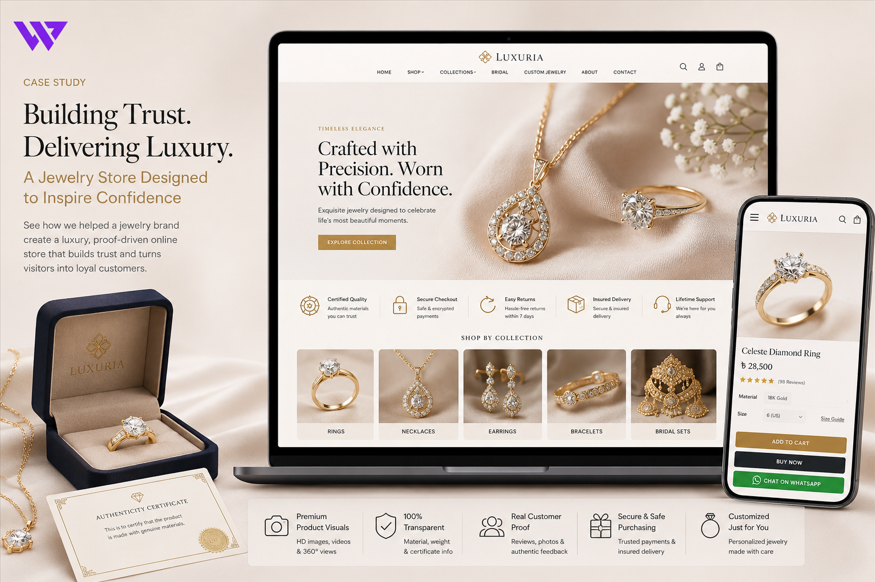
Webnion planned a responsive, luxury-focused jewelry e-commerce experience built around professional product presentation, transparent information, real customer proof, and secure purchasing actions.
The objective was to help customers understand the value behind each product while positioning the brand as credible, refined, and dependable.
2. The Business Challenge
The jewelry brand offered products across several collections, including:
Rings
Necklaces
Earrings
Bracelets
Bangles
Couple sets
Bridal jewelry
Gift items
Customized pieces
Premium collections
However, jewelry customers often have important questions before purchasing:
What material is used?
Is the product gold, silver, plated, or imitation?
What is the product weight?
Which ring or bracelet size should I choose?
Does the product look the same in real life?
Is a certificate or authenticity document included?
What is covered by the warranty?
Can the product be exchanged?
Is gift packaging available?
Can the design be customized?
How will the product be delivered securely?
If these questions remain unanswered, customers may hesitate even when they like the design.
The brand faced several common challenges:
Premium products did not have a premium presentation
Material information was inconsistent
Close-up craftsmanship details were missing
Product sizes were difficult to understand
Customers repeatedly asked about authenticity
Social media reviews were disconnected from product pages
Return and exchange policies were not visible enough
High-value products required stronger checkout reassurance
Mobile product pages felt crowded
Custom order requests were managed manually
The website needed to combine luxury design with practical proof.
3. Project Objectives
The project was planned around the following objectives:
Present the jewelry brand professionally
Create a premium visual experience
Explain materials and product details clearly
Help customers choose the correct size
Build confidence through product proof
Display real customer reviews
Communicate authenticity without unsupported claims
Present warranty, return, and exchange information
Support secure online ordering
Improve mobile product discovery
Promote bridal and gift collections
Support customized jewelry inquiries
Create a scalable platform for future collections
Every section was designed to reduce uncertainty and strengthen buyer confidence.
4. Our Strategy
We planned the shopping experience around the main questions a customer asks before buying jewelry online:
What is it made from?
How will it look and fit?
What proof supports the product?
What happens if there is a problem?
The intended customer journey was:
Discover the collection → Explore the product → Review material and craftsmanship → Confirm size → Check proof and reviews → Understand policies → Add to cart or request customization
The visual presentation created desire, while structured information helped customers evaluate the product logically.
This balance allowed the website to feel luxurious without hiding important purchasing details.
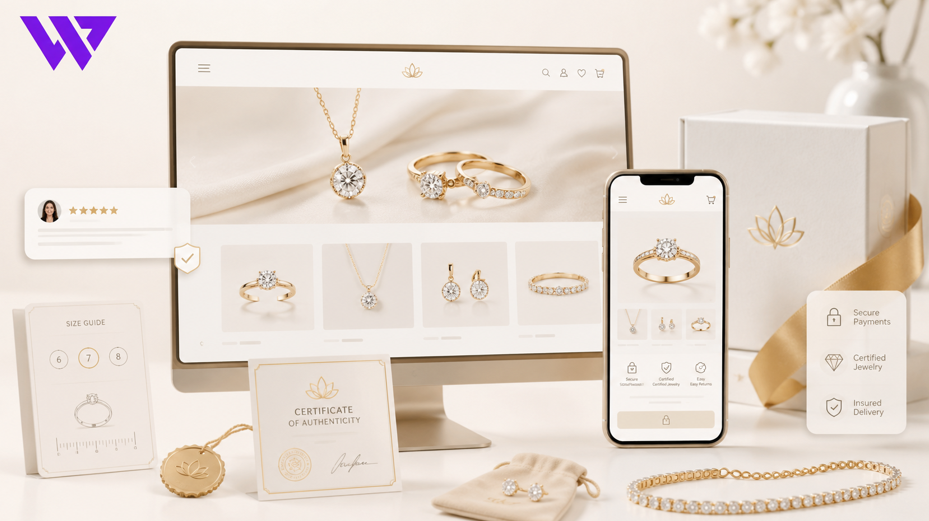
5. Creating a Luxury Brand Experience
Luxury is communicated through consistency rather than excessive decoration.
The website design used:
Clean and spacious layouts
High-quality product photography
Elegant typography
Refined brand colors
Controlled use of gold or metallic accents
Consistent product cards
Balanced white space
Premium packaging visuals
Subtle interactions
Clear purchasing actions
The design avoided overcrowded banners, aggressive discount graphics, and unnecessary animation.
Each product received enough visual space to communicate quality and craftsmanship.
The experience remained refined from the homepage through checkout.
6. Organizing Jewelry Collections
A clear collection structure helped customers discover products according to their needs.
The catalog could be organized into:
Rings
Earrings
Necklaces
Bracelets
Bangles
Bridal collections
Couple jewelry
Everyday jewelry
Luxury collections
Gift sets
New arrivals
Best sellers
Customized designs
Customers could also browse according to:
Occasion
Material
Price range
Design style
Recipient
Collection
Availability
This made product discovery easier without forcing visitors to browse the entire catalog.
7. Premium Product Photography
Customers need to inspect jewelry visually before purchasing.
The product experience could include:
Front product view
Side and back views
Close-up craftsmanship
Clasp or fastening details
Stone setting
Texture and finishing
Product worn by a model
Scale comparison
Packaging presentation
Short product videos
Close-up photography helped customers evaluate details that are difficult to explain through text.
Model images helped them understand how the product might look when worn.
Consistent lighting and backgrounds also strengthened the brand’s premium positioning.
8. Product Video and 360-Degree Presentation
Static photography may not fully communicate shine, movement, depth, or finishing.
Product videos could show:
How the jewelry reflects light
How it looks from different angles
How a clasp opens and closes
How the product moves when worn
Packaging and unboxing
Size and proportion
Where practical, a 360-degree product view could provide a more complete visual experience.
This does not replace physical inspection, but it gives customers more confidence than a single image.
9. Transparent Material Information
Jewelry descriptions needed to explain materials clearly.
Depending on the product, the page could include:
Base material
Plating information
Metal purity where verified
Stone type
Stone-setting method
Product weight
Product dimensions
Finish
Care instructions
Country of origin
Package contents
The website avoided vague descriptions that could create unrealistic expectations.
If a product was plated rather than solid gold or silver, that distinction needed to be communicated clearly.
Transparent information protects customer trust and reduces disputes after delivery.
10. Authenticity and Product Proof
Customers may hesitate to purchase high-value jewelry if authenticity information is unclear.
The website could present available proof such as:
Hallmark details where applicable
Material certificate where verified
Stone certificate where provided
Product serial or reference number
Brand packaging
Purchase invoice
Warranty card
Clear product-source information
Real product photography
Only verified claims should be displayed.
The website should not describe a product as certified, hallmarked, or authentic unless the business can provide supporting evidence.
This proof-driven approach helps the brand build long-term credibility.
11. Ring and Bracelet Size Guidance
Incorrect sizing is a major concern in jewelry e-commerce.
The website could provide a clear size guide explaining:
Ring diameter
Finger circumference
Local and international size conversion
Bracelet length
Wrist measurement
Necklace length
Adjustable product information
Measurement instructions
Visual diagrams could show customers how to measure correctly at home.
Each product page could also clarify:
Available sizes
Whether resizing is possible
Whether the item is adjustable
Custom-size availability
Exchange conditions for sizing issues
Clear sizing information reduces incorrect orders and unnecessary exchanges.
12. Product Variations
Jewelry products may include several options, such as:
Size
Color
Material
Plating
Stone color
Chain length
Engraving
Gift packaging
Matching set
Customized design
Each variation could maintain separate:
Price
Stock
SKU
Product image
Availability
Production time
Customers were required to select the necessary options before adding the product to the cart.
This reduced incomplete orders and helped the team understand exactly what needed to be prepared.
13. Customized Jewelry Requests
Some customers wanted personalized jewelry rather than a standard product.
The website could support customization requests for:
Name jewelry
Initial pendants
Engraved rings
Couple sets
Custom stone colors
Bridal pieces
Size modifications
Personalized gift packaging
The request process could collect:
Preferred product
Material
Size
Design reference
Engraving text
Budget
Required date
Customer contact information
A structured request form reduces repetitive conversations and gives the business clearer project requirements.
The final price and delivery time should be confirmed before production begins.
14. Bridal Jewelry Presentation
Bridal customers often purchase coordinated sets and require more guidance.
A bridal collection page could present:
Complete set images
Individual items included
Material and stone details
Available colors
Product weight
Wearing style
Customization options
Production timeline
Packaging
Consultation action
Bridal products could be organized according to:
Wedding ceremony
Reception
Engagement
Traditional style
Minimal style
Premium collection
This helped customers explore complete looks rather than isolated products.
15. Gift-Focused Shopping Experience
Jewelry is frequently purchased as a gift.
The website could organize products for:
Birthdays
Anniversaries
Weddings
Engagements
Valentine’s Day
Eid
Mother’s Day
Corporate gifts
Personal milestones
Gift-related features could include:
Premium gift box
Gift message
Recipient delivery
Price-hidden invoice
Occasion-based recommendations
Gift bundles
Delivery-date request
A structured gift experience makes purchasing easier for customers who may not understand jewelry details.
16. Clear Pricing
Luxury pricing needs transparency.
The product page could show:
Current price
Previous price where applicable
Selected variation price
Customization charge
Gift packaging charge
Delivery charge
Advance payment requirement
Final payable amount
For products whose price depends on weight or market rates, the website should explain how the final price is determined.
Customers should understand whether the displayed price is fixed, estimated, or subject to confirmation.
Clear pricing prevents confusion after the customer reaches checkout or contacts the sales team.
17. Customer Reviews and Real Proof
Customer experiences are especially important for jewelry businesses.
Reviews could help potential buyers understand:
Product appearance
Finishing quality
Packaging
Size accuracy
Delivery condition
Gift experience
Customer support
Customization result
Overall satisfaction
Useful proof formats included:
Product-specific reviews
Customer photos
Unboxing videos
Social media feedback
Written testimonials
Verified purchase indicators
Custom-order results
Reviews were connected to relevant products or collections where possible.
This made the proof more useful than a generic testimonial section.
18. Building Trust Through Business Transparency
The website needed to make the business easy to verify and contact.
Trust-building information could include:
Business name
Contact number
Business location
Social media profiles
Support hours
Delivery coverage
Order process
Payment methods
Return and exchange policies
Warranty information
Product-care guidance
This helps customers understand who they are purchasing from and what support is available after the order.
A premium-looking website without clear business information may still fail to build trust.
19. Return, Exchange, and Warranty Information
High-value purchases require clear policies.
The website could explain:
Return eligibility
Exchange conditions
Size-related exchange rules
Customized product restrictions
Damaged-item reporting period
Warranty coverage
Warranty exclusions
Required product condition
Processing time
Customer-support process
Customized or engraved products may require different policies from standard products.
These differences needed to be communicated before purchase.
Clear policies reduce uncertainty and protect both the customer and the business.
20. Secure Payment Experience
Customers need reassurance when paying for jewelry online.
The checkout experience could communicate:
Available payment methods
Secure transaction process
Cash-on-delivery availability
Advance payment requirements
Bank or mobile payment options
Order confirmation
Payment receipt
Refund process
Customer-support access
For high-value or custom products, partial or advance payment may be required.
The website should explain these terms clearly before the order is finalized.
21. Delivery and Packaging
Jewelry requires careful handling.
The website could explain:
Protective packaging
Premium presentation box
Tamper-resistant packaging
Delivery coverage
Estimated delivery time
Delivery charges
Tracking availability
Inspection guidance
Damaged-package reporting
Packaging images helped customers understand how the product would arrive.
For gift buyers, premium packaging also increased perceived value.
22. Mobile-Friendly Luxury Shopping
Many customers discover jewelry products through Facebook, Instagram, TikTok, Messenger, and mobile advertisements.
The mobile experience was designed to help customers:
Browse collections
View product images
Zoom into details
Watch product videos
Review materials
Check sizes
Select variations
Read customer reviews
Understand policies
Add products to the cart
Request customization
Large images, clear selectors, readable text, and accessible buttons were prioritized.
The premium experience remained consistent without making the mobile page slow or difficult to navigate.
23. Mobile Performance
High-resolution product images can slow down a jewelry website.
The experience was planned with attention to:
WebP or optimized image formats
Responsive image sizes
Lazy loading
Efficient front-end structure
Limited heavy effects
Optimized fonts
Clean code
Compressed product videos
Appropriate caching
Faster loading supports customer trust and helps visitors arriving from paid campaigns explore products without unnecessary waiting.
24. Search and Filtering
The website could help customers narrow the catalog using:
Product type
Collection
Material
Stone
Size
Color
Occasion
Price range
New arrivals
Best sellers
Gift products
Availability
A customer looking for a specific product, such as a silver-colored adjustable ring within a budget, could reach relevant items more quickly.
Better filters support both discovery and purchase intent.
25. Product Comparison
Customers may want to compare similar products before deciding.
A comparison experience could include:
Product image
Material
Stone
Size
Weight
Price
Warranty
Availability
Customer rating
Packaging
This helped customers understand why two visually similar products may have different prices.
Comparison also strengthened the perception of transparency.
26. Cart Experience
The cart preserved the customer’s exact selections.
It could display:
Product image
Product name
Selected size
Selected material
Selected color
Engraving details
Gift packaging
Quantity
Unit price
Additional charges
Subtotal
This gave customers an opportunity to confirm their choices before checkout.
It also helped the order-processing team prepare the correct product.
27. Checkout Experience
The checkout journey was designed to remain clear and secure.
It could include:
Customer details
Delivery address
Product summary
Selected variations
Customization details
Shipping charge
Payment option
Advance payment
Final order total
Policy confirmation
The customer could review the complete order before submitting it.
Transparent checkout information reduced uncertainty at the final stage of the purchase.
28. Design Approach
The visual direction focused on luxury, credibility, craftsmanship, and clarity.
The design system included:
Elegant typography
Refined product photography
Clean backgrounds
Balanced spacing
Premium brand accents
Consistent collection layouts
Clear pricing hierarchy
Proof-focused product sections
Mobile-responsive interfaces
Focused purchase buttons
Visual appeal attracted attention, while transparent product information supported confidence.
The website felt premium without becoming difficult to use.
29. Key Features Delivered
The luxury jewelry e-commerce solution included:
Responsive e-commerce design
Premium jewelry collections
High-resolution product galleries
Product videos
360-degree presentation where supported
Clear material details
Product weight and dimensions
Authenticity proof where verified
Size guides
Product variations
Variation-level pricing and stock
Customized jewelry requests
Bridal collections
Gift-focused product discovery
Customer reviews and photo proof
Warranty information
Return and exchange policies
Secure payment guidance
Premium packaging presentation
Mobile search and filtering
Product comparison
Clear cart and checkout
Scalable collection structure
Each feature was selected to reduce uncertainty, communicate quality, and support high-value purchasing decisions.
30. The Outcome
The completed solution created a more refined and trustworthy online experience for the jewelry brand.
Customers could explore collections, inspect product details, understand materials, confirm sizes, review proof, and understand policies before ordering.
The brand gained a structured platform for presenting premium collections, supporting customized requests, promoting bridal jewelry, and building customer confidence.
No unverified revenue, conversion, or customer-growth percentages are being claimed. However, the website directly addressed several trust barriers that commonly affect online jewelry purchases.
31. Business Value Created
The website helps the jewelry brand:
Present products more professionally
Strengthen premium brand positioning
Explain product materials clearly
Build confidence through proof
Reduce repetitive authenticity questions
Improve size selection
Support customized orders
Promote bridal and gift collections
Display reviews more effectively
Communicate policies transparently
Improve mobile shopping
Reduce incorrect product expectations
Support secure high-value orders
Add future collections more easily
The project demonstrates that luxury design becomes more effective when it is supported by evidence, transparency, and a dependable purchasing process.
32. Why This Project Matters
Jewelry customers do not purchase based on appearance alone.
They also need confidence in the material, size, craftsmanship, business, payment process, and after-sales support.
A beautiful website may attract interest, but trust determines whether the customer continues.
A proof-driven jewelry store connects:
Premium presentation
Detailed product information
Authenticity evidence
Customer experiences
Clear policies
Secure purchasing actions
This turns the website into a credible digital showroom rather than a simple product catalog.
33. Frequently Asked Questions
Why is proof important for an online jewelry store?
Customers cannot physically inspect the product. Material details, certifications where verified, real images, reviews, and policies help reduce uncertainty.
Can the website display ring and bracelet sizes?
Yes. Product pages can include available sizes, measurement instructions, conversion charts, and custom-size information.
Can each jewelry variation have a separate price?
Yes. Size, material, stone, plating, engraving, and packaging options can maintain separate prices and availability.
Can customers request customized jewelry?
Yes. A structured request form can collect design preferences, size, material, engraving, budget, and required date.
Can customer photos and videos be added?
Yes. Real customer proof can be connected to products, bridal collections, or custom designs.
Can the website display certificates?
Yes, when genuine and available. Certification or hallmark claims should only be shown when the business has supporting proof.
Can the store support advance payments?
Yes. High-value or customized orders can require partial or full advance payment, with the terms communicated clearly.
Is the website optimized for mobile customers?
Yes. Product galleries, size selectors, reviews, customization options, cart, and checkout can be optimized for smartphones.
Can the brand add new collections later?
Yes. The structure can support additional products, bridal collections, gift items, materials, and custom designs.
34. Need a Luxury E-commerce Website for Your Jewelry Brand?
A premium jewelry website should do more than look elegant.
It should help customers understand product quality, verify important details, choose the right size, and purchase with confidence.
Webnion designs and develops responsive e-commerce websites for:
Jewelry brands
Bridal jewelry businesses
Luxury retailers
Gift stores
Customized product businesses
Fashion accessory brands
Gold and silver retailers
Growing online sellers
We create digital shopping experiences that combine luxury presentation, product proof, customer trust, and secure purchasing journeys.
Build a jewelry e-commerce website that reflects your craftsmanship and gives customers the confidence to choose your brand.