Details
How a Fitness Equipment Store Combined Product Education with Conversion-Focused Design
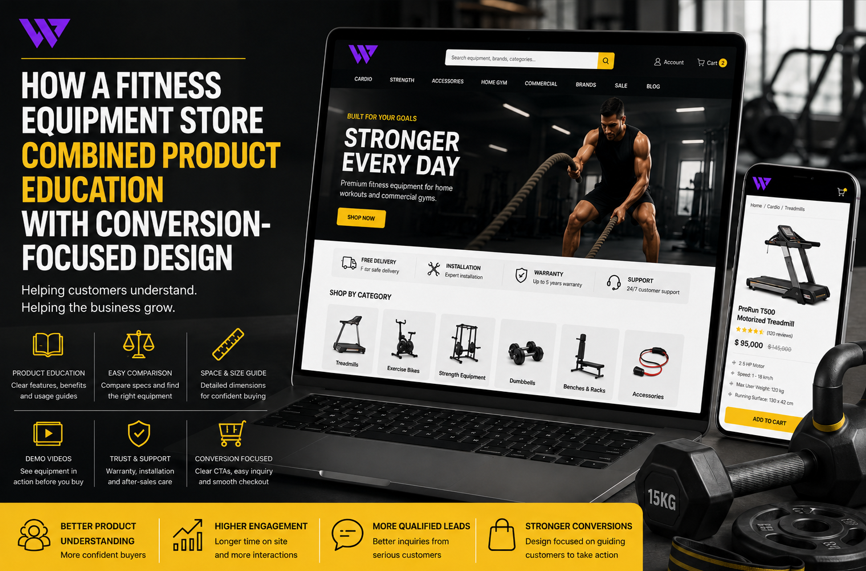
How a Fitness Equipment Store Combined Product Education with Conversion-Focused Design

1. Project Overview
A growing fitness equipment store needed an e-commerce website that could do more than display machines, accessories, and prices.
The business offered fitness products for home users, gyms, trainers, offices, and commercial fitness facilities. Its catalog included treadmills, exercise bikes, dumbbells, benches, resistance equipment, strength machines, yoga accessories, recovery tools, and home-gym packages.
Fitness equipment is usually a higher-consideration purchase. Customers often need to understand product size, weight capacity, exercise purpose, required space, assembly, warranty, and delivery conditions before placing an order.
A basic product page with one image and a short description could not answer these questions clearly.
Webnion planned a responsive e-commerce experience that combined product education with conversion-focused website design.
The goal was to help customers understand which equipment matched their goals, compare suitable options, and complete an inquiry or purchase with greater confidence.
2. The Business Challenge
Fitness customers have different goals, budgets, physical spaces, and experience levels.
Some customers want a simple home workout setup, while others need a complete commercial gym solution.
Before purchasing, they may ask:
- Which equipment is suitable for home use?
- How much space does the machine require?
- What is the maximum supported user weight?
- Does it require electricity?
- Is installation included?
- Which muscle groups can be trained?
- Is the product suitable for beginners?
- What warranty and service support are available?
- Can several products be purchased as a package?
- How much does delivery cost?
- Can a commercial quotation be requested?
The store faced several common challenges:
- Technical specifications were difficult to scan
- Customers could not understand the difference between similar machines
- Product descriptions focused on features without explaining practical value
- Home and commercial products were mixed together
- Customers repeatedly asked about space and weight capacity
- Product videos were not connected to relevant pages
- Delivery and installation information was unclear
- Mobile product pages contained too much information
- High-value products required stronger trust signals
- Commercial inquiries lacked important project details
The website needed to educate customers while keeping the path toward purchase clear.
3. Project Objectives
The project was planned around the following objectives:
- Organize fitness equipment clearly
- Explain product features in practical language
- Help customers shop according to fitness goals
- Present dimensions and space requirements
- Communicate user-weight capacity accurately
- Improve product comparison
- Support home and commercial customers
- Present warranty and service information clearly
- Improve mobile product discovery
- Simplify quotation and purchase actions
- Promote complete equipment packages
- Build a scalable platform for future products
Every section was designed to support both customer understanding and business conversion.
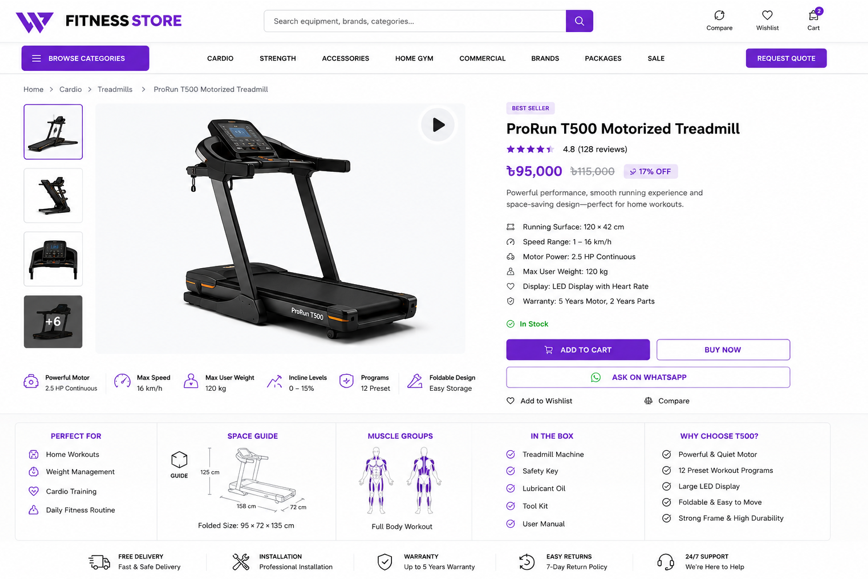
4. Our Strategy
We planned the shopping journey around the questions customers ask before investing in fitness equipment.
The intended journey was:
Identify a fitness goal → Choose an equipment category → Understand product benefits → Review specifications → Confirm space and capacity → Compare options → Purchase or request a quotation
The website did not present every technical detail with equal importance.
Instead, information was organized into layers:
- Practical product summary
- Key benefits
- Main specifications
- Space and installation requirements
- Detailed technical information
- Warranty and support
- Purchase or inquiry action
This helped beginners understand products without removing the details experienced buyers needed.
5. Shopping by Fitness Goal
Many customers know what they want to achieve but do not know which equipment they need.
The website could organize products by goals such as:
- Cardio training
- Strength training
- Weight management support
- Home workouts
- Full-body workouts
- Flexibility and mobility
- Functional training
- Recovery and stretching
- Commercial gym setup
- Office wellness
Goal-based collections created a more natural shopping experience.
A customer interested in cardio training could explore treadmills, exercise bikes, rowing machines, steppers, and related accessories in one place.
The website avoided promising guaranteed physical or medical outcomes.
Product recommendations were presented as general shopping guidance rather than professional fitness or medical advice.
6. Organizing Equipment Categories
The catalog was divided into clear categories, including:
- Treadmills
- Exercise bikes
- Elliptical trainers
- Rowing machines
- Dumbbells
- Weight plates
- Benches and racks
- Strength machines
- Resistance bands
- Kettlebells
- Yoga and mobility products
- Boxing equipment
- Recovery accessories
- Home-gym packages
- Commercial gym equipment
Clear categories helped customers reach relevant products without searching through one large catalog.
The structure also made future product expansion easier.
7. Separate Home and Commercial Experiences
Home users and commercial gym buyers have different priorities.
Home customers may focus on:
- Compact size
- Noise
- Foldability
- Easy storage
- Budget
- Simple installation
- Beginner-friendly use
Commercial buyers may focus on:
- Durability
- Continuous use
- User capacity
- Quantity
- Floor planning
- Installation
- Service support
- Bulk pricing
The website created separate paths for:
- Home fitness equipment
- Professional trainers
- Commercial gyms
- Hotels and resorts
- Corporate fitness rooms
- Rehabilitation and wellness facilities
- Educational institutions
This helped customers reach products suited to their environment.
8. Benefit-Led Product Summaries
Technical features were translated into practical customer benefits.
Instead of showing only:
“2.5 HP motor”
The product page could explain:
“A motor designed to support regular home walking and jogging sessions.”
Instead of showing only:
“Foldable frame”
The page could explain:
“Folds after use to reduce the floor space required for storage.”
This approach helped non-technical customers understand why a feature mattered.
Detailed technical specifications remained available further down the product page.
9. Key Feature Presentation
The most important features were shown in a clear, scannable format.
Depending on the product, these could include:
- Motor capacity
- Speed range
- Resistance levels
- Incline options
- Maximum supported user weight
- Product dimensions
- Folded dimensions
- Display information
- Training programs
- Connectivity
- Power requirement
- Product weight
- Warranty period
Icons and short labels improved scanning, especially on mobile devices.
The website avoided overcrowding the top of the page with every minor specification.
10. Product Dimensions and Space Planning
Fitness equipment must fit safely inside the customer’s available space.
The product page could clearly display:
- Product width
- Product length
- Product height
- Folded dimensions
- Recommended clearance
- Doorway requirements
- Product weight
- Packaging dimensions
- Installation space
Visual measurement diagrams helped customers understand the actual footprint.
The website could also remind customers to measure:
- Room space
- Doorways
- Staircases
- Lift access
- Ceiling height
- Delivery path
This reduced unsuitable orders and delivery problems.
11. User-Weight Capacity
Maximum supported user weight is an important purchasing detail.
The information needed to be visible and consistent across:
- Product cards
- Product page
- Comparison table
- Cart
- Quotation
- Sales communication
The website avoided presenting weight capacity as a recommendation for medical or training suitability.
Customers were encouraged to follow manufacturer instructions and seek qualified advice where personal health or physical limitations were involved.
12. Exercise and Muscle-Group Education
Some customers may not understand which movements a product supports.
The website could explain:
- Main exercise types
- Primary muscle groups involved
- Secondary muscle groups
- Common training uses
- Available adjustments
- Example exercise positions
For example, an adjustable bench page could explain its support for:
- Flat pressing
- Incline pressing
- Seated shoulder exercises
- Dumbbell training
- Supported core exercises
This educational content helped customers understand product versatility.
It did not guarantee specific fitness results.
13. Product Demonstration Videos
Videos were connected directly to relevant products.
A video could show:
- Product overview
- Setup process
- Folding and storage
- Resistance adjustment
- Display operation
- Exercise examples
- Maintenance basics
- Safety checks
- Packaging and delivery
- Installation
Video demonstrations helped customers understand products that were difficult to explain through images alone.
They also reduced repetitive questions about operation and assembly.
14. Product Image Experience
The product gallery could include:
- Front view
- Side and back views
- Display and control panel
- Adjustment points
- Folding mechanism
- Material details
- Product in a room
- Human scale reference
- Included accessories
- Packaging
- Commercial installation
Consistent images made comparison easier across similar products.
Lifestyle images helped customers understand how much space equipment might require in a real environment.
15. Structured Technical Specifications
Detailed specifications were organized into clear groups.
General Information
- Brand
- Model
- Product type
- Recommended environment
- Available color
Performance
- Motor
- Speed
- Incline
- Resistance
- Training programs
- Display functions
Physical Information
- Dimensions
- Folded dimensions
- Product weight
- Maximum supported user weight
- Frame material
Power and Connectivity
- Power requirement
- Bluetooth
- Application support
- Audio connection
- Charging ports
Warranty and Support
- Warranty duration
- Parts coverage
- Service availability
- Installation information
This structure made technical content easier to scan and compare.
16. Product Comparison
Customers often compare similar equipment before making a decision.
A comparison experience could include:
- Product image
- Price
- Recommended use
- Dimensions
- Weight capacity
- Motor or resistance
- Foldability
- Training programs
- Warranty
- Installation
- Customer rating
- Stock availability
This helped customers understand why two similar-looking machines had different prices.
Comparison also reduced the need to open multiple product pages repeatedly.
17. Beginner-Friendly Product Guidance
New fitness customers may feel uncertain about technical equipment.
The website could label products using helpful descriptions such as:
- Suitable for beginners
- Designed for regular home use
- Compact for smaller rooms
- Suitable for advanced strength setups
- Intended for commercial environments
- Easy to store
- Requires professional installation
These labels were based on product characteristics and verified manufacturer information.
They were not presented as personal exercise prescriptions.
18. Product Filters
Customers could narrow products using filters such as:
- Equipment category
- Fitness goal
- Home or commercial use
- Price range
- Maximum user weight
- Product size
- Foldable design
- Brand
- Availability
- Warranty
- Customer rating
Filters helped customers reduce a large catalog to relevant options.
A clear reset action allowed visitors to start again easily.
19. Mobile Product Discovery
Many customers discovered fitness products through Facebook, Instagram, YouTube, Google search, and mobile advertising.
The mobile experience allowed them to:
- Browse categories
- Shop by goal
- Filter products
- View key benefits
- Review specifications
- Watch demonstration videos
- Compare products
- Request a quotation
- Add products to the cart
- Contact the business
Buttons, comparison tables, videos, and specification sections were adapted for smaller screens.
The product page used expandable sections to prevent information overload.
20. Conversion-Focused Page Structure
The product page was designed to support action without becoming aggressive.
Important actions could include:
- Add to Cart
- Buy Now
- Request a Quotation
- Ask on WhatsApp
- Book a Consultation
- Check Delivery
- Compare Product
These actions appeared at relevant points throughout the page.
Customers could take action after viewing key product details without scrolling back to the top.
Sticky mobile actions could keep the next step visible without covering content.
21. Product-Specific WhatsApp Inquiries
A WhatsApp button could open a prepared message containing useful product information.
For example:
Hello, I am interested in this fitness equipment.
Product: Foldable Home Treadmill
Maximum User Weight: 120 kg
Delivery Location: Dhaka
Product Link: [product page]
Please confirm availability, delivery, and installation details.
This gave the sales team immediate context.
It also reduced confusion caused by customers sending unclear screenshots.
22. Delivery and Installation Information
Fitness equipment often requires special handling.
The website could explain:
- Delivery coverage
- Delivery charge
- Floor or lift requirements
- Assembly availability
- Installation charge
- Installation timeline
- Packaging removal
- Product inspection
- Damaged-item reporting
- Commercial installation process
Customers could submit delivery details before completing a high-value order.
This helped the business identify access or installation challenges earlier.
23. Warranty and Service Support
Warranty information was treated as a key trust element.
Product pages could include:
- Warranty duration
- Motor warranty
- Parts warranty
- Frame warranty
- Service conditions
- Installation requirements
- Warranty exclusions
- Support contact
- Maintenance recommendations
Warranty claims were shown only when supported by actual business or manufacturer policies.
Clear warranty information helped customers understand what support was available after purchase.
24. Maintenance Education
Fitness equipment requires proper maintenance.
The website could provide general guidance on:
- Cleaning
- Belt adjustment
- Lubrication
- Bolt inspection
- Storage
- Electrical safety
- Cable inspection
- Upholstery care
- Scheduled servicing
Maintenance guidance helped customers protect equipment condition.
Technical servicing was recommended only through qualified personnel.
25. Safety Information
Safety information needed to remain visible.
Depending on the equipment, the product page could include:
- Assembly instructions
- Maximum supported weight
- Required clearance
- Electrical precautions
- Emergency-stop information
- Child-safety guidance
- Proper footwear guidance
- Stable-surface requirements
- Manufacturer warnings
The website did not claim that any exercise product was risk-free.
Customers were encouraged to follow product instructions and consult qualified professionals where appropriate.
26. Home-Gym Packages
Some customers wanted a complete setup rather than individual products.
The store could create packages such as:
- Beginner home-gym package
- Compact apartment setup
- Strength-training package
- Cardio package
- Functional training package
- Premium home gym
- Personal trainer starter package
Each package could explain:
- Products included
- Space required
- Individual product value
- Package price
- Total savings
- Installation
- Delivery
- Warranty
Packages helped customers understand how related products could work together.
27. Commercial Gym Quotations
Commercial customers needed a structured quotation process.
The website could collect:
- Business name
- Contact person
- Facility type
- Location
- Floor area
- Required equipment
- Quantity
- Budget range
- Opening date
- Floor plan
- Installation requirements
- Service expectations
This gave the sales team enough information to prepare a relevant proposal.
It also separated serious project leads from general product questions.
28. Floor Plan and Reference Uploads
Commercial buyers could upload:
- Floor plan
- Room measurements
- Existing gym photos
- Equipment list
- Interior design reference
- Brand requirements
These files helped the business recommend product quantities and layouts.
The final plan still required professional verification before installation.
29. Consultation Booking
Customers could request consultations for:
- Home-gym planning
- Commercial gym setup
- Hotel fitness rooms
- Corporate wellness spaces
- Equipment replacement
- Product comparison
- Space planning
The consultation form could collect:
- Project type
- Available space
- Budget
- Required products
- Location
- Preferred meeting time
This helped the sales team prepare before speaking with the customer.
30. Customer Reviews and Project Proof
Social proof helped customers evaluate product quality and service.
The website could display:
- Product-specific reviews
- Customer home-gym photos
- Commercial installation projects
- Delivery feedback
- Installation feedback
- Video testimonials
- Trainer feedback
- Repeat-purchase experiences
Reviews were connected to relevant products or project types.
The business needed permission before publishing customer photos or private conversations.
31. Completed Gym Project Portfolio
Commercial buyers wanted proof that the business could manage larger installations.
Project pages could include:
- Client type
- Project location
- Facility size
- Equipment supplied
- Installation scope
- Project images
- Challenges
- Solution
- Final setup
Real project proof strengthened trust more effectively than unsupported promotional statements.
32. Transparent Pricing
The product page could show:
- Current price
- Previous price
- Discount
- Delivery charge
- Installation charge
- Package price
- Advance payment requirement
- Final payable amount
For commercial projects, the website could explain that final pricing depended on quantity, delivery, installation, and project requirements.
This prevented unrealistic expectations before quotation.
33. Cart Experience
The cart could display:
- Product image
- Product name
- Selected variation
- Quantity
- Unit price
- Delivery information
- Installation option
- Discount
- Subtotal
Customers could review the complete selection before checkout.
For products requiring quotation, the cart could redirect customers to a structured inquiry process instead of forcing standard checkout.
34. Simplified Checkout
For ready-to-purchase products, checkout could collect:
- Customer name
- Phone number
- Delivery address
- Shipping area
- Floor information
- Lift availability
- Installation request
- Order notes
- Payment method
The summary showed:
- Selected products
- Product total
- Delivery charge
- Installation charge
- Discount
- Final total
Clear checkout information reduced unexpected costs and delivery confusion.
35. Search Engine Optimization Structure
The website supported SEO through clear product, category, and educational pages.
Potential search-focused pages could include:
- Fitness equipment online store
- Home gym equipment
- Treadmill for home use
- Commercial gym equipment supplier
- Exercise bike online
- Strength training equipment
- Compact fitness equipment
- Gym setup services
- Fitness equipment buying guide
Each page could include:
- Helpful introduction
- Product recommendations
- Technical guidance
- Buying considerations
- Frequently asked questions
- Internal links
- Descriptive titles
- Meta descriptions
- Image alt text
Content was written for customers first and avoided unnatural keyword repetition.
36. Educational Content Strategy
The brand could publish useful articles such as:
- How to choose a treadmill for home
- How much space a home gym requires
- Questions to ask before buying an exercise bike
- Home versus commercial fitness equipment
- How to compare treadmill specifications
- Basic fitness equipment maintenance
- How to plan a compact home gym
- What to consider before setting up a commercial gym
Educational content helped customers research products and strengthened SEO.
It was not presented as personalized medical or exercise advice.
37. Internal Linking
Internal links connected educational pages, categories, and products.
For example:
- A treadmill guide could link to treadmill products
- A home-gym article could link to compact packages
- A product page could link to maintenance guidance
- A commercial gym page could link to consultation booking
- A strength category could link to benches, racks, and weights
This helped customers continue their journey without repeatedly returning to the main navigation.
38. Analytics and Conversion Tracking
The website could track actions such as:
- Category visits
- Product views
- Video plays
- Specification-section interactions
- Product comparisons
- WhatsApp clicks
- Quotation requests
- Consultation bookings
- Add-to-cart events
- Checkout starts
- Completed orders
This data helped the business understand which products and information generated interest.
No unverified sales or conversion results were claimed.
39. Design Approach
The visual direction focused on energy, clarity, confidence, and practical product education.
The design system included:
- Clean light backgrounds
- Strong product images
- Bold but readable typography
- Clear specification cards
- Benefit-focused icons
- Structured product sections
- Mobile-friendly accordions
- Visible trust elements
- Consistent action buttons
- Responsive layouts
The design felt active and professional without becoming visually overwhelming.
Product education and conversion actions remained balanced.
40. Key Features Delivered
The fitness equipment e-commerce solution included:
- Responsive e-commerce website design
- Fitness-goal-based discovery
- Home and commercial product paths
- Organized equipment categories
- Benefit-led product summaries
- Structured technical specifications
- Dimensions and space guidance
- Weight-capacity information
- Exercise-use education
- Demonstration videos
- Product comparison
- Mobile search and filters
- Product-specific WhatsApp inquiries
- Delivery and installation information
- Warranty and service details
- Maintenance education
- Safety information
- Home-gym packages
- Commercial quotation requests
- Floor-plan uploads
- Consultation booking
- Customer reviews
- Project portfolio
- Transparent pricing
- Mobile cart and checkout
- SEO-friendly educational content
- Internal linking
- Conversion tracking
- Scalable product management
Each feature was selected to improve product understanding, trust, lead quality, and purchase confidence.
41. The Outcome
The completed solution created a clearer and more conversion-focused shopping experience for the fitness equipment store.
Customers could identify suitable equipment, understand practical benefits, review dimensions and capacity, watch demonstrations, compare products, and choose the right purchase or inquiry action.
The business gained a structured platform for home equipment sales, commercial quotations, educational content, and future product expansion.
No unverified sales, traffic, fitness-result, or conversion percentages are being claimed. However, the website directly addressed the product-understanding and purchasing barriers common in fitness equipment e-commerce.
42. Business Value Created
The website helps the fitness equipment store:
- Explain technical products clearly
- Reduce repetitive customer questions
- Improve product comparison
- Support home and commercial customers
- Communicate dimensions and capacity
- Present warranty and installation clearly
- Generate more structured commercial inquiries
- Promote complete gym packages
- Improve mobile shopping
- Build trust through reviews and projects
- Support educational SEO content
- Track meaningful customer actions
- Simplify high-value purchasing decisions
- Add future products more easily
The project demonstrates that conversion-focused design works best when customers receive enough education to make a confident decision.
43. Why This Project Matters
Fitness equipment customers do not only need attractive images and prices.
They need to understand whether a product matches their goals, available space, budget, and intended use.
A website that pushes customers toward checkout without answering these questions may create hesitation instead of conversion.
A stronger fitness equipment website connects:
- Product discovery
- Practical education
- Technical specifications
- Demonstration
- Comparison
- Trust
- Delivery and installation
- Clear purchasing actions
The website becomes a digital product consultant rather than a basic equipment catalog.
44. Frequently Asked Questions
Why is product education important for a fitness equipment store?
Customers need to understand product use, size, specifications, capacity, installation, and maintenance before purchasing higher-value equipment.
Can customers shop according to fitness goals?
Yes. Products can be organized around cardio, strength, home workouts, mobility, and other general fitness goals.
Can the website show equipment dimensions?
Yes. Product pages can display full dimensions, folded size, product weight, and recommended clearance.
Can customers compare multiple machines?
Yes. A comparison system can show price, dimensions, performance, weight capacity, warranty, and other specifications side by side.
Can demonstration videos be added?
Yes. Product pages can include setup, operation, maintenance, and exercise demonstration videos.
Can the website support commercial gym inquiries?
Yes. A structured quotation form can collect facility size, required equipment, budget, quantity, location, and project timeline.
Can customers upload a gym floor plan?
Yes. Floor plans and reference images can be collected for commercial consultation and planning.
Can delivery and installation charges be shown separately?
Yes. Product pages, quotations, cart, and checkout can present delivery and installation costs clearly.
Is the website suitable for mobile customers?
Yes. Product education, videos, comparison, inquiries, cart, and checkout can be optimized for smartphones.
Does the website provide personal fitness or medical advice?
No. The website presents verified product information and general educational guidance. Customers should seek qualified professional advice for personal health, exercise, or medical concerns.
45. Need an E-commerce Website for Your Fitness Equipment Business?
A fitness equipment website should help customers understand products before asking them to make a high-value purchase.
Webnion designs and develops responsive e-commerce websites for:
- Fitness equipment stores
- Home-gym brands
- Commercial gym suppliers
- Sports retailers
- Wellness businesses
- Equipment manufacturers
- Personal trainers
- Growing online retailers
We create product experiences that combine education, technical clarity, customer trust, mobile usability, and conversion-focused design.
Build a fitness equipment website that helps customers understand their options and gives your team a stronger system for sales, quotations, and long-term growth.