Details
How a Perfume Brand Created a Premium E-commerce Experience Around Product Storytelling
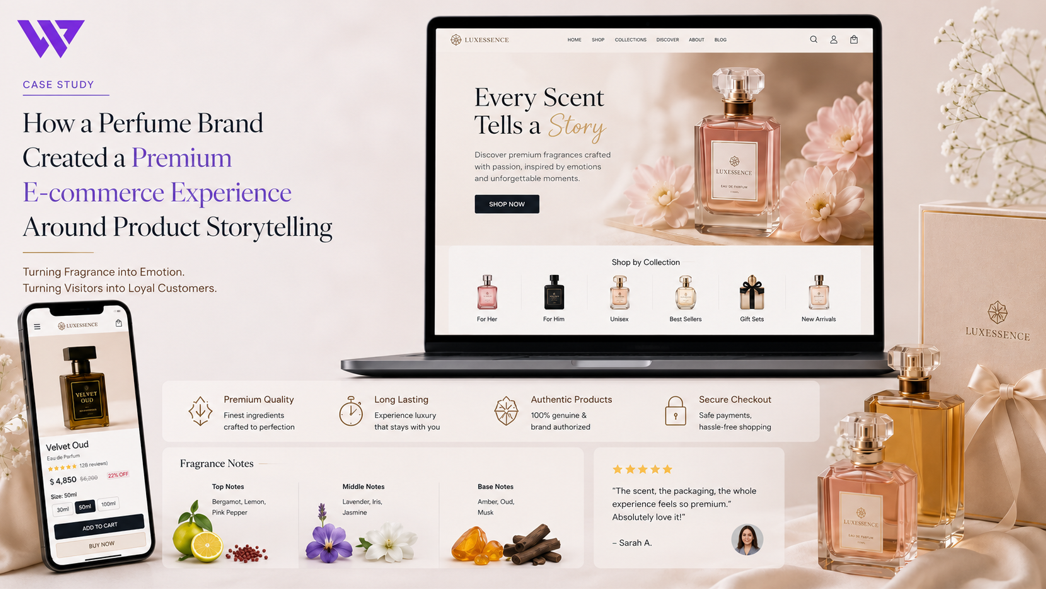
How a Perfume Brand Created a Premium E-commerce Experience Around Product Storytelling

1. Project Overview
A growing perfume brand needed an e-commerce website that could do more than display fragrance bottles and prices.
Perfume is an emotional and personal product. Customers often choose a fragrance based on mood, personality, occasion, ingredients, concentration, and the story behind the scent.
When customers shop online, they cannot smell the perfume before purchasing. The website therefore needed to create confidence through visual presentation, clear fragrance information, product storytelling, customer reviews, and a refined shopping experience.
Webnion planned a responsive perfume e-commerce platform focused on premium product presentation, fragrance education, brand storytelling, and simple purchasing actions.
The goal was to help customers imagine the fragrance experience before placing an order while positioning the brand as professional, trustworthy, and premium.
2. The Business Challenge
Selling perfume online creates challenges that do not exist with many ordinary products.
Customers may want to understand:
- What the fragrance smells like
- Which notes appear first
- How the scent develops over time
- Whether it is suitable for men, women, or both
- How long it may last
- Whether it is appropriate for daily use or special occasions
- What bottle sizes are available
- Whether the product is authentic
- How other customers describe the fragrance
- Whether a gift package is available
A basic product page with one image and a short description could not answer these questions effectively.
The brand faced several common problems:
- Fragrances looked too similar in a standard product grid
- Product descriptions felt generic
- Customers struggled to compare scent profiles
- Fragrance notes were not presented clearly
- Bottle sizes and concentrations caused confusion
- Premium products lacked premium presentation
- Customers repeatedly asked about longevity and suitability
- Gift sets were difficult to explain
- Mobile product pages felt crowded
- The website did not communicate the brand’s unique identity
The business needed an experience that connected emotion, product education, and online sales.
3. Project Objectives
The project was planned around the following objectives:
- Present the perfume brand professionally
- Give every fragrance a distinctive identity
- Use storytelling to communicate emotion and personality
- Explain top, middle, and base notes clearly
- Help customers select fragrances by occasion and preference
- Present concentration, size, and variation information accurately
- Improve product comparison
- Build trust around authenticity and quality
- Support mobile shoppers
- Promote gift sets and fragrance bundles
- Simplify the cart and checkout journey
- Create a scalable structure for future collections
Every part of the website was designed to make fragrance discovery more engaging and purchasing more confident.
4. Our Strategy
We planned the customer journey around one central idea:
Customers should understand the feeling of the fragrance before they see the purchase button.
The intended journey was:
Discover the collection → Understand the fragrance story → Explore the scent notes → Identify the right occasion → Review size and concentration → Check customer feedback → Add to cart
Instead of treating every perfume as another product, the website gave each fragrance its own narrative.
The emotional story attracted attention, while structured product information supported the final decision.
This balance helped the brand communicate luxury without sacrificing clarity.
5. Building a Premium Brand Experience
Premium positioning depends on consistency.
The website needed to feel refined from the first screen through checkout.
The visual approach included:
- Clean and spacious layouts
- Large fragrance photography
- Elegant typography
- Controlled use of brand colors
- Subtle visual effects
- Consistent product cards
- Refined buttons
- Clear content hierarchy
- Premium packaging visuals
- Mobile-responsive sections
The design avoided excessive banners, aggressive discount labels, and crowded product grids.
Products were given enough space to communicate value and craftsmanship.
6. Product Storytelling
Every fragrance was presented through a short story designed to help customers imagine its personality.
A product story could describe:
- The mood behind the fragrance
- The type of person it represents
- The environment or memory that inspired it
- The occasion where it feels most appropriate
- The emotional experience of wearing it
For example, a fragrance could be described as:
A warm evening scent created for confident moments, combining rich woods, smooth amber, and a subtle touch of spice.
This type of description communicates more than a technical list of ingredients.
It gives the customer a reason to connect with the product.
7. Fragrance Notes Presentation
Fragrance notes were organized into three understandable stages.
Top Notes
The first impression customers experience immediately after application.
Middle Notes
The central character of the fragrance that appears after the opening notes settle.
Base Notes
The deeper elements that remain longer and define the final scent experience.
The website could present these notes through:
- Clear text labels
- Ingredient imagery
- Fragrance note icons
- Simple visual timelines
- Short explanations
- Product-specific descriptions
This helped non-technical customers understand how a fragrance may develop over time.
8. Fragrance Families
Customers may not know a specific perfume name, but they often understand the type of scent they prefer.
The website could organize products by fragrance family, including:
- Floral
- Woody
- Citrus
- Fresh
- Oriental
- Amber
- Musk
- Spicy
- Fruity
- Aquatic
- Gourmand
This created a more intuitive discovery journey.
A customer who prefers fresh or woody fragrances could reach relevant products without browsing the entire catalog.
9. Shopping by Occasion
Fragrance choice often depends on where and when it will be worn.
The website could guide customers through occasion-based collections such as:
- Everyday fragrances
- Office and professional use
- Evening wear
- Weddings and celebrations
- Romantic occasions
- Summer fragrances
- Winter fragrances
- Travel-friendly perfumes
- Luxury gifts
This approach helps customers discover products based on real-life needs rather than technical categories alone.
10. Gender and Unisex Collections
The product catalog could include:
- Perfumes for men
- Perfumes for women
- Unisex fragrances
- Couple sets
- Gift collections
These categories were presented clearly without making the navigation feel restrictive.
Unisex perfumes could be described through scent personality and notes rather than traditional gender-based language alone.
This made fragrance discovery more flexible and customer-focused.
11. Concentration and Longevity Information
Customers may see terms such as Eau de Parfum or Eau de Toilette without understanding the difference.
The website could explain common concentration types:
- Parfum
- Eau de Parfum
- Eau de Toilette
- Eau de Cologne
- Perfume oil
- Body mist
Each product could also include carefully worded information about expected performance.
The website avoided making unsupported promises about exact longevity because fragrance performance can vary depending on skin type, climate, application, and storage.
Clear explanations helped customers make more informed decisions while protecting trust.
12. Bottle Size and Product Variations
Perfume products may be available in several variations, including:
- 30 ml
- 50 ml
- 75 ml
- 100 ml
- Travel size
- Tester
- Gift package
- Perfume oil
- Spray version
Each variation could maintain separate:
- Price
- Stock
- SKU
- Product image
- Discount
- Availability
Customers were required to select the correct size or version before adding the item to the cart.
This reduced incomplete orders and improved inventory accuracy.
13. High-Quality Product Photography
Perfume presentation depends heavily on visual quality.
The product experience could include:
- Front bottle image
- Side and back views
- Packaging image
- Cap and spray details
- Bottle texture
- Size comparison
- Lifestyle photography
- Gift box presentation
- Ingredient-inspired visuals
Consistent lighting and backgrounds made the catalog feel more premium.
Detailed images also helped customers understand what they would receive.
14. Authenticity and Trust
Customers may hesitate to purchase perfume online because of concerns about counterfeit products.
The website helped strengthen trust through:
- Professional product photography
- Clear brand and product information
- Authenticity statements where verified
- Visible business details
- Warranty or replacement information where applicable
- Delivery policies
- Return conditions
- Customer reviews
- Secure checkout indicators
- Direct customer-support options
Trust was created through transparent information rather than unsupported claims.
The website communicated what the business could genuinely guarantee.
15. Customer Reviews and Fragrance Experiences
Perfume reviews can help customers understand a scent from a real user’s perspective.
Reviews could discuss:
- Opening impression
- Scent character
- Preferred occasion
- Packaging quality
- Projection
- Personal experience
- Gift suitability
- Delivery condition
- Overall value
Product-specific reviews were connected to the relevant fragrance.
This allowed potential buyers to evaluate opinions about the exact product they were considering.
16. Fragrance Discovery Quiz
A fragrance discovery quiz could help customers who were unsure what to choose.
The quiz could ask about:
- Preferred scent family
- Daily or occasional use
- Desired mood
- Season
- Strength preference
- Favourite notes
- Gift recipient
- Budget range
Based on the responses, the website could suggest relevant fragrances.
This created a more guided and personalized discovery experience.
It also helped customers explore products beyond the best-selling items.
17. Gift Sets and Premium Bundles
Perfume brands often serve gift buyers.
The website could present gift sets with:
- Included products
- Bottle sizes
- Packaging details
- Individual value
- Gift set price
- Total savings
- Occasion recommendation
- Stock status
- Optional gift message
Possible bundles included:
- Perfume and body spray
- Couple fragrance set
- Travel-size collection
- Perfume and oil combination
- Wedding gift set
- Seasonal gift box
Clear bundle presentation made the offer easier to understand and increased its perceived value.
18. Sample and Discovery Sets
Some customers want to test fragrances before purchasing a full bottle.
The website could support:
- Sample-size perfumes
- Discovery sets
- Miniature collections
- Trial bundles
- Redeemable sample offers where supported
Each set could explain:
- Included fragrances
- Sample size
- Fragrance family
- Recommended use
- Price
- Full-bottle options
This gives new customers a lower-risk way to experience the brand.
19. Mobile-Friendly Fragrance Shopping
Many perfume customers discover products through Facebook, Instagram, TikTok, YouTube, and mobile advertisements.
The mobile experience was designed to help them:
- Browse fragrance collections
- Read product stories
- Explore scent notes
- View bottle images
- Select sizes
- Check prices
- Read customer reviews
- Explore gift sets
- Add products to the cart
- Contact the business
The content was divided into readable sections so long product stories did not overwhelm mobile users.
Images, buttons, selectors, and review cards remained comfortable on smaller screens.
20. Product Comparison
Customers may want to compare perfumes with similar prices or fragrance families.
A comparison experience could include:
- Product image
- Fragrance family
- Top notes
- Middle notes
- Base notes
- Concentration
- Bottle size
- Price
- Recommended occasion
- Customer rating
This helped customers identify meaningful differences without switching repeatedly between several product pages.
21. Search and Filtering
The website could allow customers to search and filter by:
- Product name
- Brand
- Fragrance family
- Gender
- Occasion
- Concentration
- Bottle size
- Price range
- New arrivals
- Best sellers
- Gift sets
- Availability
This made a growing catalog easier to explore.
Customers with clear preferences could reach relevant products faster.
22. Cart and Checkout Experience
The cart preserved the selected fragrance details.
It could show:
- Product image
- Fragrance name
- Selected size
- Concentration
- Gift option
- Quantity
- Unit price
- Discount
- Subtotal
The checkout journey was structured around:
- Customer information
- Delivery details
- Payment method
- Order summary
- Shipping charge
- Final payable amount
The same product and pricing information remained consistent from the product page through order completion.
This transparency helped reduce uncertainty at the final stage.
23. Design Approach
The website design focused on emotion, luxury, clarity, and conversion.
The design system included:
- Elegant serif and clean supporting typography
- Premium product photography
- Spacious layouts
- Refined color combinations
- Consistent product cards
- Clear price presentation
- Subtle animations
- Responsive sections
- Focused purchase buttons
- Story-driven product pages
The website felt premium without becoming difficult to navigate.
The customer could enjoy the brand experience while still reaching important product information quickly.
24. Key Features Delivered
The perfume e-commerce experience included:
- Responsive e-commerce website design
- Premium fragrance collections
- Product storytelling
- Top, middle, and base note presentation
- Fragrance family categories
- Occasion-based discovery
- Gender and unisex collections
- Concentration information
- Bottle-size variations
- Variation-specific stock and pricing
- High-quality image galleries
- Customer reviews
- Fragrance comparison
- Gift sets and bundles
- Sample and discovery sets
- Mobile-friendly product pages
- Search and filters
- Clear cart summaries
- Simplified checkout
- Contact and customer-support options
- Scalable collection structure
Each feature was selected to make fragrance discovery more emotional, educational, and trustworthy.
25. The Outcome
The completed solution created a more premium and informative online experience for the perfume brand.
Customers could understand the personality of each fragrance, explore its notes, identify suitable occasions, compare available products, and select the correct size before ordering.
The brand gained a stronger platform for presenting collections, launching new fragrances, promoting gift sets, and building long-term customer relationships.
No unverified revenue, traffic, or conversion percentages are being claimed. However, the website directly addressed several common barriers that make online perfume purchases difficult.
26. Business Value Created
The website helps the perfume brand:
- Present fragrances more professionally
- Create stronger emotional connections
- Explain scent profiles clearly
- Reduce repetitive customer questions
- Support customers who cannot test products physically
- Improve product discovery
- Present gift sets more effectively
- Build trust around authenticity
- Support mobile shoppers
- Communicate premium brand positioning
- Launch new collections more easily
- Build a scalable foundation for online sales
The project demonstrates that product storytelling can transform a fragrance from a simple item into a memorable brand experience.
27. Why This Project Matters
Perfume is difficult to communicate through a screen.
Customers cannot smell the fragrance, so the website must help them imagine it.
A generic product description cannot create that experience.
A well-designed perfume website connects:
- Visual presentation
- Emotional storytelling
- Fragrance education
- Customer reviews
- Product variations
- Clear purchasing actions
This helps customers move from curiosity to confidence.
The website becomes a digital fragrance consultant, not merely an online product list.
28. Frequently Asked Questions
Why is storytelling important for a perfume website?
Storytelling helps customers understand the personality, mood, and intended experience of a fragrance they cannot smell online.
Can the website display fragrance notes?
Yes. Top, middle, and base notes can be presented through text, icons, imagery, or structured sections.
Can customers shop by fragrance family?
Yes. Products can be organized into floral, woody, fresh, citrus, oriental, musk, and other fragrance families.
Can each bottle size have separate pricing and stock?
Yes. Every size or concentration can maintain independent stock, price, SKU, and availability.
Can the website support perfume gift sets?
Yes. Gift sets can display included products, bottle sizes, packaging, total value, price, and savings.
Can customers compare multiple perfumes?
Yes. A comparison tool can help customers review notes, concentration, occasion, size, price, and ratings side by side.
Is the website optimized for mobile customers?
Yes. Product stories, notes, images, selectors, reviews, cart, and checkout can be optimized for smartphones.
Can the brand add future collections?
Yes. The structure can support new fragrances, seasonal launches, gift sets, samples, and limited collections.
29. Need an E-commerce Website for Your Perfume Brand?
A premium perfume website should do more than display bottles.
It should help customers understand the story, personality, notes, and value behind every fragrance.
Webnion designs and develops responsive e-commerce websites for:
- Perfume brands
- Fragrance retailers
- Luxury product businesses
- Cosmetics stores
- Gift businesses
- Personal-care brands
- Multi-brand perfume shops
- Growing online retailers
We create digital shopping experiences that combine premium presentation, product storytelling, customer trust, and clear purchasing journeys.
Build a perfume e-commerce website that helps customers experience your brand before they open the bottle.