Details
How a Gadget Shop Made Technical Products Easier to Compare and Order
How a Gadget Shop Made Technical Products Easier to Compare and Order

1. Project Overview
A growing gadget shop needed an e-commerce website that could present technical products clearly, help customers compare available options, and make online ordering easier from both desktop and mobile devices.
The store offered products such as smartwatches, headphones, speakers, mobile accessories, chargers, power banks, computer accessories, grooming devices, and other consumer electronics.
Unlike ordinary products, gadgets often include detailed specifications, compatibility requirements, model differences, warranty information, and multiple price points. Customers may like a product but still hesitate because they cannot quickly understand whether it matches their needs.
Webnion planned a responsive gadget e-commerce experience focused on clear technical information, faster comparison, organized categories, and a simple purchasing journey.
The objective was to help customers make informed decisions without depending on repeated Messenger, WhatsApp, or phone conversations.
2. The Business Challenge
Customers purchasing gadgets online usually compare several products before making a decision.
They may want to know:
- Which model offers better features
- Whether the product supports their device
- What accessories are included
- How much battery backup it provides
- Whether a warranty is available
- Which version is currently in stock
- What the difference is between similar products
- Whether the product is original
- How delivery and payment work
- What previous customers experienced
When this information is scattered or incomplete, customers may leave the website and continue searching elsewhere.
The gadget shop faced several common challenges:
- Technical specifications were difficult to scan
- Similar products looked almost identical
- Customers repeatedly asked about compatibility
- Important features were hidden inside long descriptions
- Product categories needed better organization
- Model and color variations were confusing
- Warranty details were not presented consistently
- Customers could not compare products easily
- Mobile product pages felt overcrowded
- Ordering required too many manual conversations
The website needed to make technical products feel easier to understand and purchase.
3. Project Objectives
The project was planned around the following objectives:
- Present gadget products professionally
- Make technical specifications easier to understand
- Organize products into clear categories
- Help customers compare similar models
- Explain compatibility before purchase
- Display prices, discounts, and stock clearly
- Present warranty information consistently
- Improve mobile product discovery
- Reduce repetitive pre-purchase questions
- Simplify the cart and checkout journey
- Support future products and categories
- Build stronger customer confidence
Every section was designed to help customers move from product interest to a more informed purchase decision.
4. Our Strategy
We planned the website around the questions customers usually ask before ordering a gadget.
The intended journey was:
Discover the product → Understand its key features → Review specifications → Check compatibility → Compare alternatives → Confirm price and stock → Add to cart
Instead of presenting all technical information with equal importance, the website organized it according to customer priority.
The most important benefits and specifications appeared first. More detailed information remained available for customers who wanted to explore further.
This created a clearer experience for both technical and non-technical buyers.
5. Organizing Gadget Categories
A gadget shop may contain hundreds of products across different use cases.
The website could organize products into categories such as:
- Smartwatches
- Wireless headphones
- Speakers
- Mobile accessories
- Chargers and cables
- Power banks
- Computer accessories
- Cameras and accessories
- Gaming accessories
- Personal-care devices
- Smart home products
- New arrivals
- Best sellers
- Special offers
Clear categories help customers reach the correct product group without scrolling through an unorganized catalog.
The structure also allows the business to introduce new products without making navigation more complicated.
6. Search Designed for Technical Products
Customers often search using a model name, brand, feature, or device type.
A visible product search system helps customers find items using terms such as:
- Bluetooth headphones
- Fast charger
- Type-C cable
- Smartwatch with calling
- Wireless speaker
- Gaming mouse
- Power bank
- iPhone charger
- Laptop stand
- Noise-cancelling earbuds
Search reduces the number of steps required for customers who already know what they need.
It also helps high-intent visitors reach relevant product pages faster.
7. Clear Product Cards
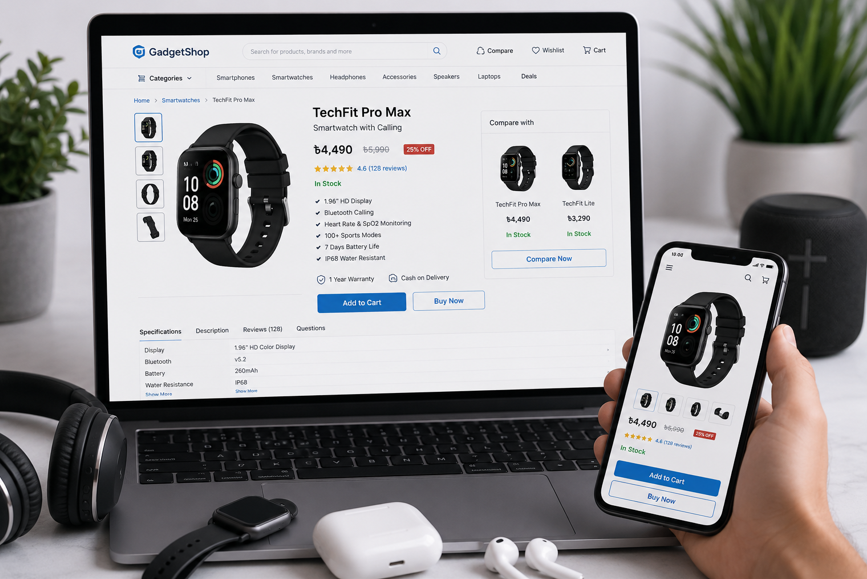
Product cards were structured to communicate essential information quickly.
Each card could include:
- Product image
- Product name
- Brand or model
- Current price
- Previous price
- Discount percentage
- Stock status
- Short feature summary
- Product details action
- Buy Now or Add to Cart action
The information was kept concise so customers could scan multiple products without becoming overwhelmed.
This helped create a balance between technical detail and fast browsing.
8. Highlighting Key Product Features
Long technical descriptions can make products difficult to understand.
The website presentation focused first on the features most likely to influence the customer’s decision.
For example, a smartwatch could highlight:
- Bluetooth calling
- Display size
- Battery backup
- Water resistance
- Health tracking
- Supported operating systems
A wireless headphone could highlight:
- Battery duration
- Charging time
- Bluetooth version
- Noise cancellation
- Microphone support
- Wireless range
This benefit-led structure helps non-technical customers understand the product without reading every specification first.
9. Structured Technical Specifications
Detailed specifications remained important for customers who wanted to compare products carefully.
The website could organize specifications into clear groups such as:
General Information
- Brand
- Model
- Product type
- Available colors
Performance
- Processor or chipset
- Connectivity
- Wireless range
- Battery capacity
- Charging time
Compatibility
- Supported devices
- Operating system support
- Connector type
- Required application
Physical Details
- Dimensions
- Weight
- Material
- Package contents
Warranty and Support
- Warranty period
- Warranty type
- Replacement conditions
- Support contact
This structure makes technical information easier to scan and compare.
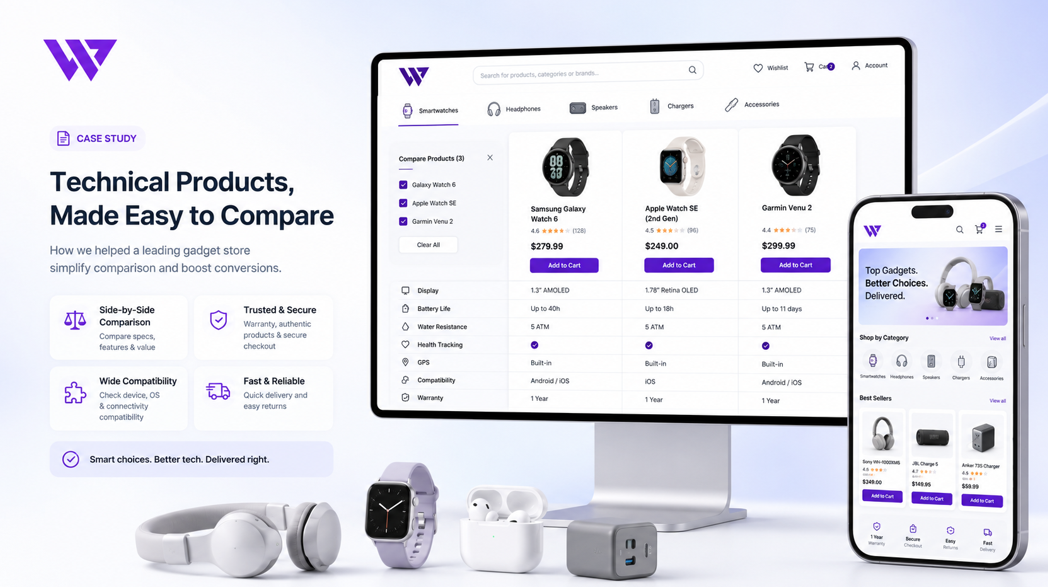
10. Side-by-Side Product Comparison
Customers often struggle to identify differences between similar gadget models.
A comparison experience can allow users to review products side by side.
The comparison may include:
- Product image
- Model
- Price
- Main features
- Battery performance
- Connectivity
- Compatibility
- Warranty
- Stock status
- Customer rating
This helps customers make a more informed decision without opening several browser tabs or contacting the store repeatedly.
The comparison process also reduces uncertainty when products have similar names but different capabilities.
11. Compatibility Information
Compatibility is one of the most important issues in gadget e-commerce.
Customers need to know whether a product will work with their existing device.
The website could clearly communicate compatibility with:
- Android devices
- iPhone or iOS
- Windows computers
- Mac devices
- Specific mobile models
- USB, Type-C, or Lightning connections
- Bluetooth versions
- Required software or applications
Compatibility warnings can also be displayed where necessary.
Clear compatibility information helps reduce incorrect orders, returns, and customer dissatisfaction.
12. Model, Color, and Storage Variations
Technical products may have several variations.
These can include:
- Model
- Color
- Storage capacity
- Cable length
- Connector type
- Package option
- Product generation
- Regional version
Each variation could maintain separate:
- Price
- Stock
- SKU
- Product image
- Availability
- Warranty information
Customers were required to select the correct option before adding the product to the cart.
This helps prevent incomplete orders and gives the business better control over variation-level inventory.
13. Accurate Stock Information
A general product stock quantity may not be enough when different models or colors have separate availability.
Variation-level stock allows the website to show which exact option is available.
This helps the business:
- Prevent unavailable orders
- Identify low-stock products
- Manage popular variations
- Update inventory more accurately
- Reduce manual confirmation
- Plan restocking decisions
Customers can make decisions with greater confidence when the availability shown on the website is clear.
14. Warranty and Authenticity Presentation
Customers may hesitate to purchase gadgets from a store if warranty and authenticity information is unclear.
The website could present:
- Official or seller warranty
- Warranty duration
- Replacement period
- Warranty conditions
- Product authenticity information
- Package contents
- Serial or model information
- Support process
These details help set realistic customer expectations.
Professional warranty presentation also makes the store appear more organized and trustworthy.
15. Product Image and Video Experience
Gadget customers want to inspect design, ports, buttons, accessories, packaging, and actual size before purchasing.
The product experience could include:
- Front and back images
- Side views
- Port and connector details
- Product dimensions
- Package contents
- Lifestyle images
- Close-up details
- Demonstration videos
- Unboxing videos
- Product-in-use visuals
Better visual presentation helps customers understand the product before ordering.
Videos are especially useful when a feature is difficult to explain through text alone.
16. Customer Reviews and Questions
Customer feedback can provide practical information that technical descriptions may not cover.
Reviews can help potential buyers understand:
- Real battery performance
- Build quality
- Sound quality
- Ease of use
- Compatibility
- Delivery condition
- Packaging
- Value for money
The website can also include common product questions and answers.
Examples include:
- Does this support iPhone?
- Is a charging cable included?
- Can I use it for gaming?
- Does it have a microphone?
- Is the product waterproof?
- What is the warranty period?
Connecting reviews and questions to the relevant product makes them more useful during the buying decision.
17. Mobile-Friendly Technical Shopping
Many gadget customers arrive from Facebook advertisements, YouTube reviews, Messenger, and mobile search.
The website was therefore designed to make technical information usable on smaller screens.
Mobile customers could:
- Search products
- Browse categories
- View key features
- Open detailed specifications
- Select a variation
- Compare prices
- Check compatibility
- Read reviews
- Add products to the cart
- Continue to checkout
Specification tables, images, buttons, and variation selectors were adapted to avoid horizontal scrolling and overcrowded layouts.
The goal was to preserve useful information without making the mobile experience difficult.
18. Clear Pricing and Promotional Offers
Gadget prices can change based on models, variations, and campaigns.
The website could present:
- Current price
- Previous price
- Discount percentage
- Variation-specific price
- Bundle price
- Campaign validity
- Delivery charge
- Final payable amount
Promotional offers could also include:
- Product and accessory bundles
- Free delivery
- Limited-time discounts
- Gift items
- Buy-more-save-more offers
- Seasonal campaigns
Transparent pricing helps customers understand the complete offer before proceeding to checkout.
19. Gadget Bundle Presentation
Related gadgets and accessories can be combined into useful bundles.
Examples include:
- Smartphone charger and cable
- Gaming mouse and keyboard
- Smartwatch and replacement strap
- Earbuds and protective case
- Laptop stand and wireless mouse
- Camera and memory card
Each bundle could show:
- Included products
- Individual value
- Bundle price
- Total savings
- Availability
- Direct purchase action
This helps customers discover accessories they may need while making the value of the offer clear.
20. Shopping Cart Experience
The cart was designed to preserve the customer’s exact product selection.
It could display:
- Product image
- Product name
- Selected model
- Selected color
- Selected variation
- Unit price
- Quantity
- Discount
- Subtotal
This allows customers to confirm their selection before checkout.
It also gives the order-processing team accurate information for packing and delivery.
21. Simplified Checkout
A complicated checkout can cause customers to abandon an otherwise successful shopping journey.
The checkout process was planned to collect the necessary information in a clear order.
This could include:
- Customer name
- Phone number
- Delivery address
- Shipping area
- Product summary
- Delivery charge
- Payment method
- Final order total
Customers could review the selected product model and variation before completing the order.
The final price remained clear from the product page through checkout.
22. Design Approach
The visual direction focused on technology, clarity, and product comparison.
The design approach included:
- Clean light backgrounds
- Strong product photography
- Clear category navigation
- Structured specification areas
- Consistent product cards
- Visible pricing
- Easy-to-use comparison controls
- Clear stock indicators
- Responsive layouts
- Focused action buttons
The design avoided excessive visual effects that could distract customers from technical information.
Products, features, and purchasing actions remained the main priorities.
23. Key Features Delivered
The gadget e-commerce solution included:
- Responsive e-commerce website design
- Organized gadget categories
- Technical product search
- Mobile-friendly filters
- Clear product cards
- Key feature highlights
- Structured specification sections
- Product comparison support
- Compatibility information
- Model and color variations
- Variation-specific stock
- Variation-specific pricing
- Warranty information
- Product image galleries
- Demonstration and unboxing videos
- Customer reviews
- Frequently asked product questions
- Product bundles
- Clear cart summaries
- Simplified checkout
- Scalable product management structure
Each feature was selected to improve product understanding, buyer confidence, and ordering accuracy.
24. The Outcome
The completed solution created a clearer shopping experience for customers purchasing technical products.
Visitors could browse categories, understand key features, review detailed specifications, check compatibility, compare similar items, and confirm the correct variation before ordering.
The gadget shop gained a more organized platform for presenting products, managing variations, supporting campaigns, and answering common customer questions.
No unverified sales, traffic, or conversion percentages are being claimed. However, the website directly addressed several common problems that can prevent customers from purchasing gadgets online.
25. Business Value Created
The website helps the gadget shop:
- Present technical products professionally
- Make specifications easier to understand
- Reduce repetitive customer questions
- Improve product comparison
- Communicate compatibility clearly
- Reduce incorrect product orders
- Present warranty information consistently
- Improve mobile shopping
- Manage variations and stock more accurately
- Promote bundles and campaigns
- Simplify cart and checkout information
- Add future gadget categories more easily
- Build stronger customer confidence
- Create a scalable foundation for online sales
The project demonstrates that technical products become easier to sell when customers can understand the differences and confirm compatibility before ordering.
26. Why This Project Matters
Many gadget stores depend on social media posts and manual conversations to explain technical products.
Although this can generate inquiries, it creates repetitive work and makes the buying process slower.
Customers may wait for answers about specifications, compatibility, stock, or warranty before deciding.
A properly structured gadget e-commerce website brings this information into the customer journey.
It helps customers:
- Find the right product
- Understand key features
- Compare available models
- Confirm compatibility
- Review warranty information
- Select the correct option
- Place an order with greater confidence
The website becomes a practical digital sales assistant rather than a basic product catalog.
27. Frequently Asked Questions
Why are technical specifications important for a gadget website?
Customers need clear specifications to understand performance, compatibility, features, and differences between similar products.
Can customers compare multiple gadgets?
Yes. A comparison feature can present price, features, compatibility, warranty, stock, and other details side by side.
Can each product model have separate stock and pricing?
Yes. Every model, color, storage option, or package variation can maintain its own stock, price, SKU, and availability.
Can the website show device compatibility?
Yes. Compatibility information can identify supported operating systems, mobile models, connectors, Bluetooth versions, or required applications.
Can product demonstration videos be added?
Yes. Product pages can include demonstration, review, installation, or unboxing videos.
Can customers see warranty information before ordering?
Yes. Warranty duration, type, conditions, and support information can be displayed clearly on the product page.
Is the website suitable for mobile customers?
Yes. Categories, specifications, comparison tools, variations, cart actions, and checkout can be optimized for smartphones.
Can the store add new gadget categories later?
Yes. The website structure can support additional products, categories, brands, models, and promotional campaigns.
28. Need an E-commerce Website for Your Gadget Business?
Selling gadgets online requires more than displaying product images and prices.
Customers need to understand features, compare models, confirm compatibility, review warranty details, and select the correct variation.
Webnion designs and develops responsive e-commerce websites for:
- Gadget stores
- Electronics retailers
- Mobile accessory businesses
- Computer shops
- Gaming accessory sellers
- Smart-device brands
- Multi-category technology stores
- Growing online retailers
We create shopping experiences that make technical products easier to understand, compare, and order.
Build a gadget e-commerce website that helps customers make informed decisions and gives your team better control over products, stock, and orders