Details
How a Fashion Brand Simplified Size and Color Selection with Variation-Based E-commerce
How a Fashion Brand Simplified Size and Color Selection with Variation-Based E-commerce

1. Project Overview
A growing fashion brand needed an e-commerce website that could present clothing products with multiple sizes, colors, prices, and stock quantities without creating confusion for customers.
Selling fashion products online is more complex than displaying a single image and price. A customer may like a product but still need to select the correct size, preferred color, and available variation before placing an order.
When these options are not organized properly, customers may choose the wrong item, contact the business repeatedly for availability, or leave the website without completing their purchase.
Webnion planned and developed a variation-based e-commerce experience that made size and color selection clearer, faster, and more convenient across desktop and mobile devices.
The project focused on simplifying product decisions while giving the business better control over variation-level pricing and inventory.
2. The Business Challenge
The fashion brand offered clothing products in different combinations.
A single product could include:
- Multiple sizes
- Multiple colors
- Different stock quantities
- Variation-specific prices
- Separate product images
- Different availability conditions
Managing these options as separate products would create unnecessary duplication and make the website difficult to maintain.
It could also create several customer-experience problems:
- Customers may not understand which sizes are available
- Out-of-stock colors may still appear orderable
- The wrong variation may be added to the cart
- Product pages may look crowded
- Mobile users may struggle to select options
- Staff may need to confirm availability manually
- Inventory may not match actual variation stock
- Customers may abandon the product page before ordering
The business needed a system that could present all valid options under one product while keeping selection simple.
3. Project Objectives
The project was planned around the following objectives:
- Make size selection clear
- Make color selection visually understandable
- Prevent customers from ordering unavailable variations
- Keep variation-level stock accurate
- Show the correct price for the selected option
- Improve the mobile shopping experience
- Reduce repetitive availability questions
- Simplify product and inventory management
- Create a smoother add-to-cart journey
- Prepare the store for future product growth
Each feature was selected to support both customer convenience and business operations.
4. Our Strategy
We structured the shopping journey around the decisions a fashion customer usually makes.
The intended journey was:
Discover the product → Review images and details → Select color → Select size → Confirm availability → Choose quantity → Add to cart
The website needed to guide customers through this process in the correct order.
Instead of displaying every possible option at once, the product page was designed to respond to the customer’s selections.
This made the experience easier to understand and reduced the risk of placing an order with an invalid size-and-color combination.
5. Variation-Based Product Structure
Each fashion item was created as one main product with multiple variations underneath it.
For example, one shirt could include:
- Black — Small
- Black — Medium
- Black — Large
- White — Small
- White — Medium
- White — Large
Each variation could maintain its own:
- Stock quantity
- Selling price
- Purchase price
- SKU
- Availability status
- Product image where required
This structure helped the brand avoid creating multiple duplicate product pages for the same item.
Customers could view one organized product page while the business could still manage every variation separately.
6. Clear Size Selection
Size is one of the most important decisions in fashion e-commerce.
If size options are unclear, customers may select the wrong item or avoid ordering completely.
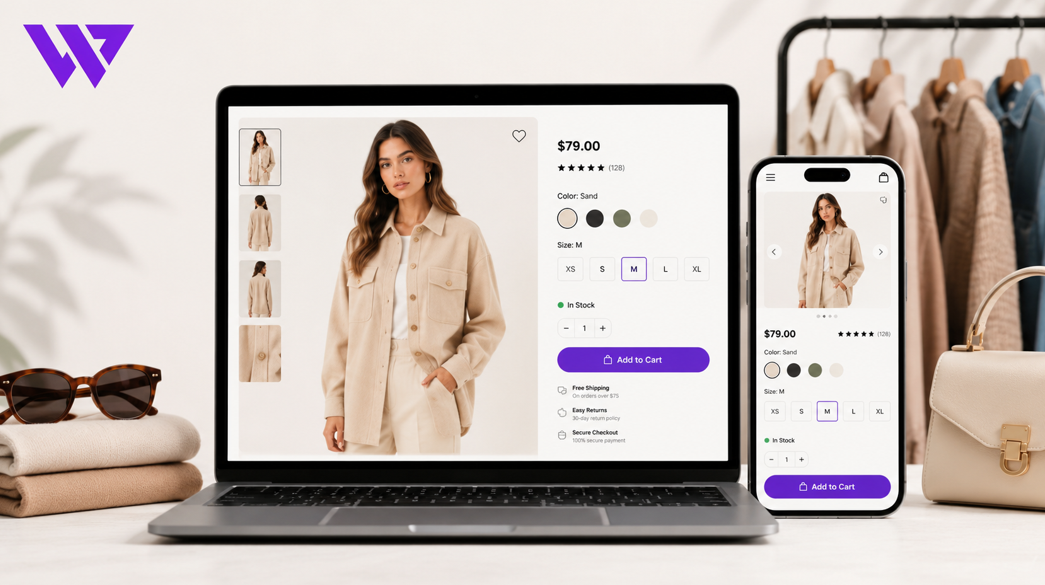
The product page was designed to present sizes as clear selection options.
Available sizes remain selectable, while unavailable sizes can be disabled or shown as out of stock.
This helps customers understand the available choices before moving toward checkout.
The clearer selection process also reduces the need to ask questions such as:
- Is Medium available?
- Do you have this in XL?
- Which sizes are currently in stock?
- Can I order this size in another color?
The website answers many of these questions directly through the product interface.
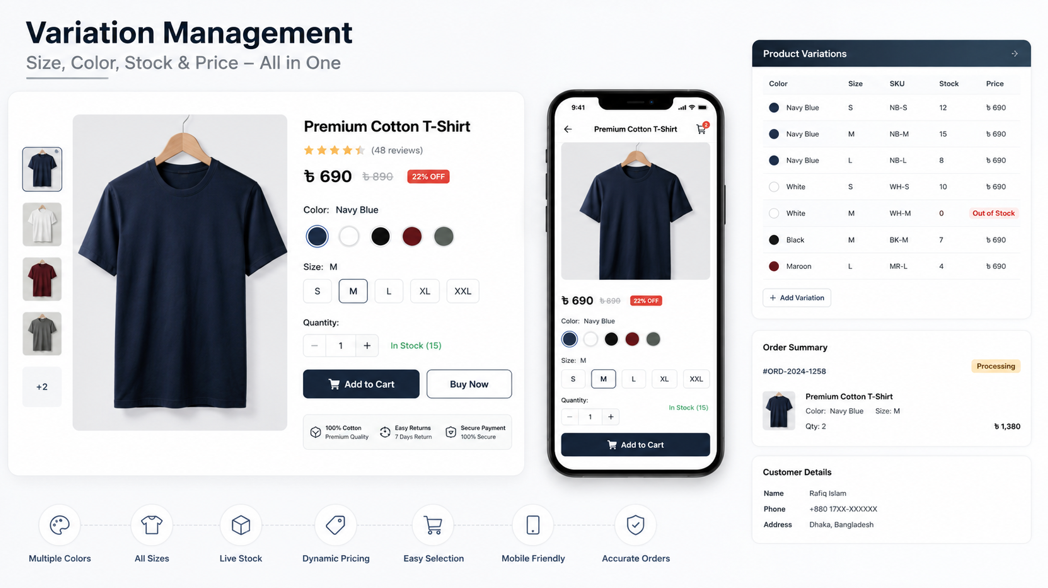
7. Visual Color Selection
Color names alone may not always be enough for fashion customers.
Customers want to understand how the product looks in their preferred color before placing an order.
The website can present color options through:
- Color swatches
- Labeled color buttons
- Variation-specific images
- Updated product previews
- Availability indicators
When customers select a color, the product information can update to show the related size options, image, price, and stock condition.
This makes the product page more interactive and gives customers greater confidence in their selection.
8. Variation-Level Inventory Control
A product may still have stock overall while a specific size-and-color combination is unavailable.
For example:
Black Medium may be available, while Black Large is sold out.
If the website uses only one general stock quantity, customers may order a variation that the business cannot deliver.
Variation-level inventory solves this problem by tracking stock for every valid combination.
This helps the business:
- Understand which variations are selling
- Identify low-stock sizes
- Prevent unavailable orders
- Update inventory more accurately
- Plan restocking decisions
- Reduce order-confirmation problems
- Maintain clearer product availability
Customers only see orderable options based on the current variation stock.
9. Dynamic Price and Product Information
Some fashion variations may have different prices.
A larger size, premium fabric, special color, or customized option may affect the final product price.
The variation system allows the displayed price to update based on the customer’s selection.
The product page can also update:
- Product image
- SKU
- Available stock
- Discount information
- Selected variation name
- Purchase availability
This gives customers accurate information before they add the product to the cart.
It also reduces disagreements caused by unclear variation pricing.
10. Required Variation Selection
Customers should not be able to add a variation-based product to the cart without choosing the required options.
The website was planned to require valid size and color selections before allowing the customer to continue.
When a customer tries to add the product without selecting a required option, the website can clearly indicate what is missing.
This protects both the customer and the business from incomplete orders.
It helps prevent situations where staff later need to contact customers and ask which size or color they intended to purchase.
11. Quantity Based on Available Stock
The quantity selector was connected to the stock of the selected variation.
If only three units of a specific size and color are available, the customer should not be able to order five.
This creates a more accurate purchasing experience and reduces the possibility of overselling.
It also helps the business maintain better consistency between website orders and actual inventory.
12. Mobile-Friendly Fashion Shopping
Fashion customers frequently discover products through Facebook, Instagram, Messenger, and mobile advertising.
Most of these visitors open product links from smartphones.
The product experience was therefore designed for smaller screens.
Mobile visitors can:
- View product images clearly
- Select colors
- Choose a size
- Check availability
- Review the updated price
- Adjust quantity
- Add the product to the cart
- Continue to checkout
Buttons, selectors, text, images, and spacing were adapted to remain comfortable on mobile devices.
The goal was to make variation selection feel simple rather than crowded or difficult.
13. Product Image Experience
Fashion buyers depend heavily on visuals.
The product page can support multiple images showing:
- Front view
- Back view
- Fabric details
- Close-up design
- Available colors
- Model presentation
- Variation-specific appearance
When appropriate, selecting a color can update the main product image.
This helps customers understand how each option looks and reduces uncertainty before purchase.
Better visual presentation also supports social media and advertising campaigns by creating a consistent product experience after customers click an ad.
14. Shopping Cart Experience
The selected variation was carried into the shopping cart with the relevant information.
The cart can clearly show:
- Product name
- Selected size
- Selected color
- Product image
- Unit price
- Quantity
- Total price
This gives customers an opportunity to confirm their choices before checkout.
It also helps the order-processing team understand exactly which variation needs to be prepared.
Clear variation information reduces mistakes during packing and fulfillment.
15. Checkout and Order Details
Variation information remains important after the customer leaves the product page.
The selected size and color should appear throughout:
- Cart
- Checkout
- Order confirmation
- Admin order view
- Invoice
- Packing process
- Customer communication
Maintaining the same information across the entire order journey reduces operational confusion.
The business can process orders more confidently because the required product variation is clearly recorded.
16. Design Approach
The website design was planned around fashion product presentation and easy decision-making.
The visual approach used:
- Clean product layouts
- Large product imagery
- Clear variation selectors
- Balanced typography
- Visible pricing
- Consistent action buttons
- Comfortable spacing
- Mobile-responsive components
- Simple cart and checkout views
The interface avoided unnecessary distractions so customers could focus on product appearance, available options, and purchase actions.
17. Key Features Delivered
The variation-based fashion e-commerce solution included:
- Responsive fashion e-commerce design
- Size-based product variations
- Color-based product variations
- Size-and-color combinations
- Variation-specific stock
- Variation-specific pricing
- Variation-specific SKU support
- Color swatches and labeled options
- Required variation validation
- Dynamic price updates
- Dynamic stock availability
- Quantity limits based on stock
- Multiple product images
- Variation details in the cart
- Variation details during checkout
- Clear admin order information
- Mobile-friendly product selection
- Scalable product management structure
Each feature was designed to reduce customer confusion and improve operational accuracy.
18. The Outcome
The completed solution created a clearer and more organized shopping experience for fashion customers.
Visitors could understand the available sizes and colors, confirm stock, view the correct price, and add a valid product variation to the cart.
The business gained a more structured way to manage products with multiple options without creating duplicate listings.
The variation system also created a stronger foundation for inventory management, order processing, product expansion, and marketing campaigns.
No unverified sales or conversion percentages are being claimed. However, the solution directly addressed common barriers that can prevent fashion customers from completing an online purchase.
19. Business Value Created
The variation-based system helps the fashion brand:
- Present product options professionally
- Reduce incorrect variation orders
- Prevent customers from ordering unavailable stock
- Minimize repetitive size and color questions
- Improve inventory accuracy
- Simplify product management
- Make mobile shopping easier
- Present pricing more clearly
- Reduce order-processing confusion
- Support a larger fashion catalog
- Improve the customer’s purchase confidence
- Prepare the business for future growth
The project demonstrates that variation management is not only a technical feature. It is an important part of customer experience and daily business operations.
20. Why This Project Matters
Many fashion businesses display size and color information through product descriptions, social media captions, or manual conversations.
This creates unnecessary work for the seller and uncertainty for the customer.
A properly structured variation system brings the information directly into the buying journey.
Customers can see what is available, choose the correct combination, and place an order without waiting for manual confirmation.
For the business, this means better product control, clearer orders, and a more scalable e-commerce process.
The website becomes more than a product catalog. It becomes a practical sales and inventory system built around the realities of fashion retail.
21. Frequently Asked Questions
What is a variation-based e-commerce website?
A variation-based website allows one product to contain multiple options, such as different sizes, colors, prices, and stock quantities.
Can each size and color have separate stock?
Yes. Every size-and-color combination can maintain its own stock quantity and availability status.
Can the product price change when a variation is selected?
Yes. The displayed price can update based on the selected size, color, material, or other product option.
What happens when a variation is out of stock?
The unavailable option can be disabled or marked as out of stock, preventing customers from ordering it.
Can customers add a product without choosing a size or color?
For products where variation selection is required, the website can prevent adding the product until the customer selects all necessary options.
Does the selected variation appear in the order?
Yes. The selected size, color, price, and other variation details can appear in the cart, checkout, admin order view, and order-processing workflow.
Is this system suitable for mobile customers?
Yes. The variation selectors, product images, quantity controls, and purchase actions can be optimized for mobile devices.
Can the system support other fashion options?
Yes. It can also support material, style, fit, length, design, bundle, or other custom product attributes.
22. Need a Variation-Based E-commerce Website for Your Fashion Brand?
Fashion customers need more than attractive product photos.
They need to understand available sizes, colors, prices, and stock before they feel confident enough to order.
Webnion designs and develops responsive e-commerce websites for:
- Fashion brands
- Clothing stores
- Boutique businesses
- Footwear sellers
- Jewelry brands
- Bridal product businesses
- Lifestyle stores
- Multi-variation product sellers
We build product experiences that simplify selection, improve inventory control, reduce ordering mistakes, and support business growth.
Create a fashion e-commerce website that helps customers select the right product and gives your team clearer control over every order.