Details
How a Hajj and Umrah Agency Built a Trust-Focused Package Landing Page
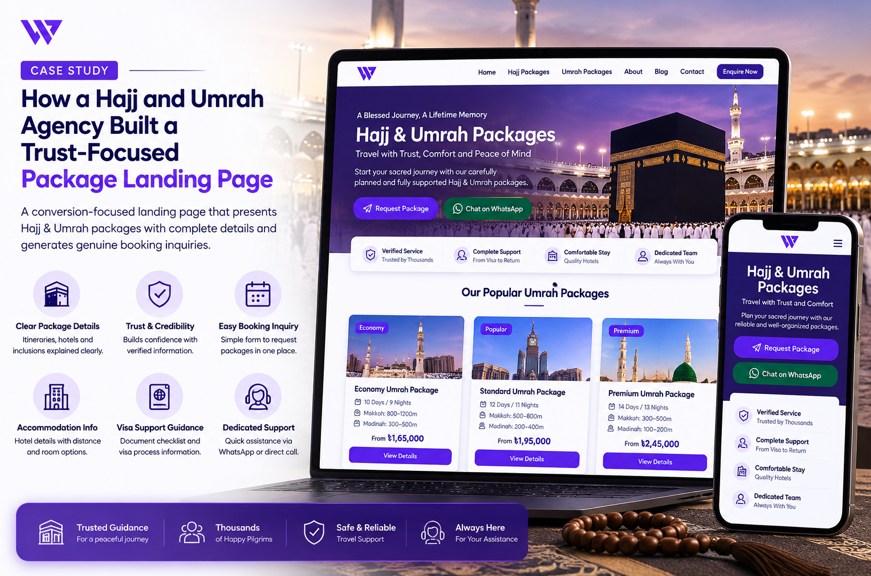
How a Hajj and Umrah Agency Built a Trust-Focused Package Landing Page

1. Project Overview
A growing Hajj and Umrah agency needed a professional landing page that could present its pilgrimage packages clearly, answer common traveler questions, and generate structured booking inquiries.
Most potential customers discovered the agency through Facebook posts, Google Search, WhatsApp promotions, community referrals, and recommendations from previous travelers.
Before contacting the agency, customers usually wanted to know:
- Which Hajj or Umrah packages were available
- What each package included
- Which hotels would be provided
- How far the accommodation was from important locations
- Whether flights and local transport were included
- What documents were required
- Whether visa-processing support was available
- How group guidance would be provided
- How much advance payment was required
- What happened after submitting a booking request
The agency previously shared much of this information through promotional images and individual messages. Important details were often scattered, while customers repeatedly asked the same questions.
Webnion planned a mobile-friendly, trust-focused package landing page that combined package information, agency credibility, traveler guidance, transparent pricing, and clear inquiry actions.
The goal was to help potential pilgrims understand the service before beginning a booking conversation.
2. The Business Challenge
Hajj and Umrah are highly significant journeys that require careful planning, documentation, coordination, and trust.
Travelers may be concerned about:
- Package authenticity
- Agency credibility
- Visa and permit procedures
- Flight arrangements
- Hotel quality
- Transportation
- Group support
- Guidance during the journey
- Additional charges
- Payment security
- Elderly traveler assistance
- Communication after arrival
The agency faced several common challenges:
- Package information was difficult to compare
- Customers relied on social media images with limited details
- Hotel and transport information was unclear
- Inclusions and exclusions were not presented consistently
- Booking inquiries lacked traveler numbers and preferred dates
- Customers could not easily verify the agency
- Mobile users struggled to read long promotional posters
- Old packages remained visible after availability changed
- Staff repeatedly answered document and payment questions
- Customers sometimes assumed that an inquiry confirmed their booking
- Different package types followed the same generic inquiry process
The business needed a landing page that reduced uncertainty and presented every important detail responsibly.
3. Project Objectives
The project was planned around the following objectives:
- Present Hajj and Umrah packages professionally
- Build trust through verified business information
- Explain package inclusions and exclusions
- Present accommodation and transport details
- Make document requirements easier to understand
- Clarify the booking and payment process
- Support family, group, and private inquiries
- Improve mobile usability
- Generate more complete booking requests
- Reduce repetitive customer questions
- Connect visitors with WhatsApp and phone support
- Create a reusable structure for future packages
Every section was designed to improve clarity, confidence, and communication.
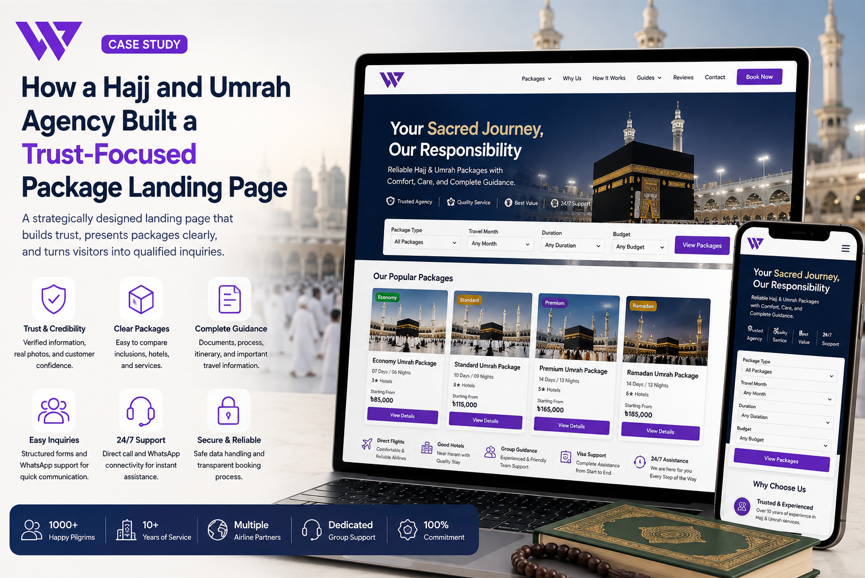
4. Our Strategy
We planned the landing page around the questions potential pilgrims usually ask before choosing an agency.
The intended journey was:
Review the package → Understand accommodation and transport → Check inclusions and exclusions → Verify agency credibility → Review the booking process → Submit an inquiry → Receive confirmation from the agency
The page focused on one main objective:
Generate a qualified Hajj or Umrah package inquiry.
Instead of sending campaign visitors to a general travel website, the agency could direct them to a focused page containing all relevant information.
5. Why a Focused Landing Page Was Used
Customers arriving from an advertisement or social media campaign were usually interested in one specific package.
A focused landing page helped maintain continuity between:
Advertisement → Package details → Trust information → Booking inquiry
The page avoided unrelated tours, excessive navigation, and unnecessary distractions.
The same landing-page structure could later support:
- Economy Umrah packages
- Premium Umrah packages
- Family packages
- Ramadan Umrah packages
- Group packages
- Private packages
- Hajj packages
- Customized pilgrimage arrangements
6. Strong Package Hero Section
The top section of the landing page immediately presented the main offer.
It could include:
- Package name
- Hajj or Umrah type
- Journey duration
- Tentative travel period
- Starting price
- Main accommodation information
- Flight inclusion status
- Primary booking action
- WhatsApp inquiry button
A visitor could quickly understand whether the package matched their basic requirements.
7. Clear Package Positioning
Every package was positioned around a defined customer need.
Examples included:
- Affordable group travel
- Family-friendly arrangements
- Premium accommodation
- Short-duration Umrah
- Ramadan travel
- Elderly traveler support
- Private group coordination
- Guided first-time pilgrimage
The page explained the practical differences between packages without using vague or exaggerated promotional claims.
8. Package Summary
A concise package summary could display:
- Number of days and nights
- Departure location
- Accommodation cities
- Hotel category
- Room-sharing option
- Transportation type
- Meal availability
- Group guidance
- Visa-support status
- Estimated price
This helped customers understand the overall package before reading the complete itinerary.
9. Detailed Package Itinerary
The journey plan was divided into clear stages.
The itinerary could explain:
- Departure and airport procedures
- Arrival and transfer
- Accommodation arrangements
- Guided religious activities
- Intercity transportation
- Scheduled visits where included
- Free or personal time
- Return journey
- Final airport transfer
The itinerary remained flexible because flight schedules, local regulations, transport conditions, and operational requirements could change.
10. Package Inclusions
The inclusion section clearly explained what the customer would receive.
Depending on the package, this could include:
- Return airfare
- Visa-processing support
- Hotel accommodation
- Airport transfers
- Intercity transportation
- Local transport
- Selected meals
- Group leader
- Religious guidance
- Ziyarat arrangements where included
- Travel bag or identification materials
- Customer support
- Applicable service charges
Only confirmed services were listed as included.
11. Package Exclusions
Exclusions were presented with equal clarity.
These could include:
- Personal expenses
- Passport-related costs
- Additional baggage
- Optional activities
- Unscheduled transportation
- Room upgrades
- Medical expenses
- Travel insurance where not included
- Charges caused by personal itinerary changes
- Services not listed in the inclusion section
Clear exclusions reduced misunderstandings about the final cost.
12. Accommodation Information
Accommodation is one of the most important parts of a pilgrimage package.
The landing page could show:
- Hotel name where confirmed
- Hotel category
- City
- Room type
- Number of nights
- Room-sharing arrangement
- Approximate location
- Available facilities
- Check-in and checkout guidance
- Alternative hotel conditions
Where a specific hotel could not be guaranteed before booking, the page explained that an equivalent category might be provided depending on availability.
13. Room-Sharing Options
Customers could review available room arrangements such as:
- Double sharing
- Triple sharing
- Quad sharing
- Family room
- Private room where available
Each option could have a separate price.
The inquiry form could collect the preferred room type before the agency contacted the traveler.
14. Flight Information
The page could explain:
- Whether airfare was included
- Departure airport
- Destination airport
- Direct or connecting flight
- Baggage allowance
- Expected airline category
- Ticket conditions
- Possible schedule changes
Flights remained subject to airline confirmation and operational availability.
The website avoided presenting tentative schedules as guaranteed.
15. Local Transportation
The transportation section could explain:
- Airport transfer
- Hotel transfer
- Intercity transport
- Shared or private vehicle
- Group bus arrangements
- Scheduled local movements
- Transport limitations
This helped customers understand how travel between key locations would be coordinated.
16. Religious Guidance and Group Support
Many travelers, especially first-time pilgrims, wanted clear guidance throughout the journey.
The package could include information about:
- Group leader
- Pre-travel orientation
- General pilgrimage guidance
- Group communication
- Meeting points
- Schedule briefings
- Support during key journey stages
- Emergency contact procedures
Any scholar, guide, or coordinator information was shown only when confirmed.
17. Pre-Travel Orientation
The agency could arrange an orientation session covering:
- Journey schedule
- Travel documents
- Airport procedures
- Accommodation
- Group rules
- Luggage preparation
- General religious guidance
- Local communication
- Emergency contacts
- Important travel reminders
The page could explain whether the session was in person, online, or both.
18. Document Checklist
A clear document section reduced repeated questions.
The general checklist could include:
- Valid passport
- Passport-size photographs
- National identification
- Required vaccination or health documents where applicable
- Traveler information form
- Relationship documents where required
- Additional documents requested by the relevant authorities
Requirements can change based on current official rules.
The landing page advised travelers to confirm the latest checklist with the agency and relevant authorities before submission.
19. Visa and Permit Support
The agency could explain the support it provided for:
- Document review
- Application assistance
- Required forms
- Submission guidance
- Status communication
- Additional-document requests
The website clearly stated that visa and permit approval depended on the relevant authorities.
The agency did not guarantee approval.
20. Traveler Eligibility Guidance
The landing page could provide general information about:
- Passport validity
- Current official requirements
- Age-related travel arrangements
- Family documentation
- Group conditions
- Health and mobility considerations
The page avoided giving definitive legal, immigration, or medical advice.
Travelers were encouraged to verify current requirements through official channels and qualified professionals.
21. Elderly Traveler Support
Some packages required additional planning for elderly travelers.
The page could explain available assistance such as:
- Wheelchair request support
- Suitable room preferences
- Group coordination
- Family companion arrangements
- Transport assistance
- Slower-paced guidance where available
The agency avoided guaranteeing medical or mobility support that had not been formally arranged.
22. Family and Group Packages
Family and group travelers could review information about:
- Room allocation
- Group size
- Child traveler arrangements
- Shared transportation
- Group leader
- Family contact information
- Special assistance requests
The inquiry form collected the number of adults, children, and elderly travelers.
This helped the agency recommend an appropriate package.
23. Transparent Package Pricing
The pricing section could show:
- Price per person
- Room-sharing price
- Private-room supplement
- Child pricing where applicable
- Visa-related charge
- Airfare status
- Booking amount
- Additional service charges
- Final payment deadline
The website clarified whether the displayed amount was:
- Fixed
- Starting from
- Estimated
- Subject to flight and hotel availability
Transparent pricing helped customers understand the expected financial commitment.
24. Booking and Payment Process
The landing page explained the booking process step by step:
- Review the package
- Submit an inquiry
- Receive availability confirmation
- Submit the required documents
- Review the final quotation
- Pay the booking amount
- Receive booking confirmation
- Complete the remaining payment
- Attend the pre-travel orientation
- Receive final travel documents
This gave customers a clear understanding of what happened after they contacted the agency.
25. Booking Request Versus Confirmed Booking
The page clearly explained that submitting an inquiry did not automatically reserve a seat.
After submission, the customer could see:
“Your package inquiry has been received. Our team will contact you to confirm availability, final pricing, document requirements, and payment instructions.”
This prevented customers from assuming that flight, hotel, visa, or group space had already been confirmed.
26. Structured Booking Inquiry Form
The form could collect:
- Full name
- Phone number
- Email address
- Selected package
- Preferred travel period
- Number of adults
- Number of children
- Number of elderly travelers
- Room preference
- Passport availability
- Departure location
- Private or group preference
- Special assistance requirements
- Additional message
- Consent confirmation
This gave the agency enough information to begin a useful consultation.
27. WhatsApp Package Inquiries
A WhatsApp button could generate a prepared message.
For example:
Hello, I am interested in this Umrah package.
Package: Premium 14-Day Umrah
Travelers: 2 Adults
Preferred Room: Double Sharing
Preferred Travel Period:
Passport Available: Yes
Departure Location: Dhaka
Package Link: [page link]
Please confirm availability, final price, and required documents.
This created more organized WhatsApp conversations.
28. Click-to-Call Support
Some customers preferred direct phone communication.
A visible call action could appear:
- In the header
- In the hero section
- Near package pricing
- In the mobile sticky bar
- Near the FAQ section
- On the contact section
This helped customers who needed clarification before submitting a form.
29. Sticky Mobile Actions
Most campaign visitors arrived through smartphones.
A sticky mobile bar could keep the following actions visible:
- Request Booking
- Call Agency
The sticky area was designed carefully so it did not cover package information.
30. Agency Verification and Trust Information
The landing page helped customers verify the agency through:
- Business name
- Office address
- Contact number
- Map
- Business hours
- Registration details where appropriate
- Approved partnerships where verifiable
- Real office photography
- Team information
- Customer-support process
Only valid and supportable credentials were displayed.
31. Real Office and Team Photography
Authentic images could include:
- Office exterior
- Reception
- Consultation area
- Travel team
- Group briefing
- Previous traveler orientation
- Customer-support desk
Real photography helped customers feel more confident than generic promotional images.
Personal photographs were published only with permission.
32. Previous Traveler Reviews
Customer feedback could discuss:
- Booking communication
- Document support
- Hotel arrangements
- Group coordination
- Transportation
- Guidance
- Customer service
- Overall journey organization
Reviews were presented as individual experiences.
The agency did not suggest that every traveler would receive identical conditions or results.
33. Completed Group Journey Galleries
With traveler permission, the landing page could show:
- Group departure
- Orientation sessions
- Airport coordination
- Hotel arrival
- Group activities
- Journey memories
- Return reception
These images provided practical evidence of previous operations.
The agency needed to respect traveler privacy before publishing identifiable photographs.
34. Frequently Asked Questions
The page could answer questions such as:
- What is included in the package?
- Is airfare included?
- Which hotels will be used?
- Is visa support provided?
- How much advance payment is required?
- Can families travel together?
- Are private rooms available?
- Is support available for elderly travelers?
- Does submitting the form confirm the booking?
- What happens if a visa is not approved?
- Can the travel date change?
- What documents are required?
A focused FAQ reduced repetitive inquiries.
35. Cancellation and Refund Information
The landing page could explain:
- Booking cancellation conditions
- Non-refundable services
- Airline ticket conditions
- Hotel cancellation rules
- Visa-processing charges
- Administrative fees
- Date-change conditions
- Refund-processing timelines
Final terms depended on the selected package and third-party service providers.
Customers received the complete conditions before payment.
36. Health and Travel Guidance
The page could provide general reminders about:
- Personal health preparation
- Required official health documents
- Regular medication
- Mobility needs
- Travel insurance
- Hydration and rest
- Seeking professional medical advice before travel
The website did not provide personalized medical advice.
Travelers with health concerns were encouraged to consult qualified healthcare professionals before booking.
37. Current Requirement Disclaimer
Hajj and Umrah travel requirements can change.
The landing page clearly explained that:
- Visa rules may change
- Permit requirements may change
- Health requirements may change
- Flight schedules may change
- Hotel availability may change
- Official travel conditions may change
- Package itineraries may require adjustment
Travelers were advised to follow the latest instructions from the relevant official authorities.
38. Mobile-First Landing Page Design
The page was optimized for customers arriving from Facebook, Google, WhatsApp, and mobile advertisements.
Mobile visitors could:
- View the package summary
- Check hotel details
- Review the itinerary
- Read inclusions and exclusions
- Check pricing
- Review document guidance
- Submit a booking inquiry
- Call or open WhatsApp
Long sections used expandable layouts to remain easy to read.
39. Fast Page Performance
The landing page was planned with attention to:
- Optimized WebP images
- Responsive image sizes
- Lazy loading
- Reduced unnecessary scripts
- Efficient fonts
- Lightweight forms
- Clean front-end code
- Browser caching
Faster loading helped campaign visitors reach the package information quickly.
40. Campaign Consistency
Advertisements and landing-page information needed to remain consistent.
If an advertisement promoted a 14-day Umrah package, the page needed to display:
- The same package
- The same duration
- The same starting price
- The same travel period
- The same major inclusions
- The same booking conditions
This reduced confusion and strengthened customer confidence.
41. Dynamic Package Management
Authorized staff could update:
- Package title
- Travel period
- Price
- Hotel information
- Flight status
- Room options
- Available seats
- Inclusions
- Exclusions
- Required documents
- Payment deadlines
- Package status
This allowed the agency to keep the landing page current without editing code manually.
42. Availability and Deadline Management
Package statuses could include:
- Available
- Limited Availability
- Waiting List
- Closed
- Sold Out
- Upcoming
The page could also show:
- Booking deadline
- Document-submission deadline
- Payment deadline
- Tentative departure period
Availability remained subject to final confirmation.
43. Booking Administration
Authorized staff could manage inquiries through an organized dashboard.
Each record could include:
- Customer name
- Phone number
- Selected package
- Traveler count
- Room preference
- Passport status
- Special assistance
- Inquiry source
- Assigned consultant
- Follow-up date
- Booking status
- Staff notes
Possible statuses included:
- New Inquiry
- Contacted
- Documents Required
- Availability Check
- Quotation Sent
- Waiting for Advance
- Booking Confirmed
- Visa Processing
- Final Payment Pending
- Travel Ready
- Completed
- Cancelled
44. Consultant Assignment
Inquiries could be assigned based on:
- Hajj or Umrah package
- Travel period
- Group type
- Customer language
- Branch
- Consultant workload
- Campaign source
This helped the correct consultant respond without duplicate follow-up from several team members.
45. Payment Tracking
The system could record:
- Package price
- Booking amount
- Visa charge
- Airfare payment
- Remaining balance
- Payment date
- Payment method
- Receipt number
- Refund or adjustment
- Payment status
This created a clearer internal booking record.
46. Traveler Document Management
After confirmation, authorized staff could manage:
- Traveler names
- Passport status
- Document checklist
- Visa status
- Room allocation
- Flight details
- Payment status
- Emergency contacts
- Special assistance requests
Sensitive traveler data required restricted access and secure handling.
47. Customer Notifications
Customers could receive notifications for:
- Inquiry received
- Documents required
- Quotation sent
- Advance received
- Booking confirmed
- Visa status update
- Payment reminder
- Orientation schedule
- Flight update
- Final travel briefing
Messages avoided exposing unnecessary passport or personal information.
48. Search Engine Optimization Structure
The landing page could support search visibility for relevant terms such as:
- Umrah package from Bangladesh
- Hajj package
- Family Umrah package
- Ramadan Umrah package
- Economy Umrah package
- Premium Umrah package
- Umrah travel agency
- Guided Umrah package
The content included useful package details instead of repeating keywords unnaturally.
SEO created a stronger discovery foundation but did not guarantee search rankings or bookings.
49. Educational Content Support
The agency could connect the landing page with helpful articles such as:
- How to prepare for an Umrah journey
- Questions to ask before choosing a package
- How to compare pilgrimage accommodation
- Understanding package inclusions and exclusions
- What documents may be required
- How group travel coordination works
- General packing guidance
- How the booking process works
The articles remained general and directed travelers to current official guidance.
50. Privacy and Traveler Information
The page explained:
- What personal information was collected
- Why it was required
- Who could access it
- How it was stored
- How long it might be retained
- Which service providers could be involved
- How customers could request correction or deletion
- How documents were protected
The public inquiry form avoided requesting passport copies unless a secure process was available.
51. Secure Form Handling
The platform could include:
- Encrypted website connection
- Form validation
- CSRF protection
- Spam prevention
- Restricted administrator access
- Role-based permissions
- Activity logging
- Scheduled backups
- Controlled data export
- Secure document uploads where supported
No website can guarantee absolute security.
However, suitable protections reduced unnecessary risk.
52. Design Approach
The visual direction focused on trust, spiritual significance, clarity, and professional travel coordination.
The design system included:
- Clean and respectful layouts
- High-quality destination imagery
- Calm color combinations
- Clear package summaries
- Structured itinerary sections
- Visible pricing
- Trust-focused business information
- Mobile-friendly inquiry forms
- Strong WhatsApp and call actions
- Responsive layouts
The design avoided excessive decorative elements and pressure-based promotional tactics.
53. Key Features Delivered
The trust-focused landing page included:
- Responsive package landing-page design
- Strong package hero section
- Detailed package overview
- Day-by-day itinerary
- Inclusions and exclusions
- Hotel information
- Room-sharing options
- Flight and transport information
- Group guidance details
- Pre-travel orientation
- Document checklist
- Visa-support explanation
- Elderly traveler support information
- Family and group inquiries
- Transparent pricing
- Booking and payment steps
- Structured booking forms
- Prefilled WhatsApp inquiries
- Click-to-call support
- Sticky mobile actions
- Agency verification information
- Previous traveler reviews
- Journey galleries
- Frequently asked questions
- Cancellation guidance
- Current-requirement disclaimer
- Dynamic package management
- Availability controls
- Booking administration
- Consultant assignment
- Payment tracking
- Traveler-document management
- Customer notifications
- SEO-friendly content
- Privacy-conscious forms
- Secure data handling
Each feature was selected to improve trust, package understanding, inquiry quality, and internal coordination.
54. The Outcome
The completed solution transformed the agency’s package promotion from scattered social media posts into one structured, trust-focused landing page.
Potential pilgrims could review the itinerary, accommodation, pricing, transport, document requirements, agency information, and booking process before submitting an inquiry.
The agency gained a more organized way to collect traveler details, assign consultants, track documents, manage payments, and communicate updates.
No unverified booking, revenue, visa-approval, or conversion percentages are being claimed. However, the landing page directly addressed the information and trust barriers that previously made package inquiries difficult to manage.
55. Business Value Created
The landing page helps the agency:
- Present packages professionally
- Build stronger customer confidence
- Reduce repetitive questions
- Explain inclusions and exclusions clearly
- Communicate hotel and transport details
- Receive more complete booking inquiries
- Support family and elderly travelers
- Clarify payment and confirmation steps
- Improve mobile campaign performance
- Keep package information updated
- Assign inquiries to consultants
- Manage traveler documents
- Track payments and booking stages
- Strengthen search visibility
- Reuse the structure for future packages
The project demonstrates that trust is created through clear information, verifiable business details, responsible communication, and an organized booking process.
56. Why This Project Matters
Potential pilgrims are not selecting an ordinary holiday package.
They need confidence in:
- The agency
- Accommodation
- Transportation
- Guidance
- Documentation
- Payment process
- Group coordination
- Support throughout the journey
A strong landing page connects:
Package discovery → Detailed information → Agency verification → Booking inquiry → Document review → Confirmation → Travel preparation
The page becomes a digital consultation and trust-building platform rather than a simple promotional poster.
57. Frequently Asked Questions
Can the landing page display multiple Hajj and Umrah packages?
Yes. Separate landing pages or package sections can be created for economy, premium, family, group, and seasonal options.
Does submitting the form confirm the booking?
No. The agency must confirm availability, final pricing, documents, flight, hotel, and payment requirements.
Can customers request packages through WhatsApp?
Yes. A prepared message can include the package, traveler count, room preference, travel period, and page link.
Can hotel and room information be shown?
Yes. Hotel category, location, number of nights, and room-sharing options can be presented clearly.
Can the website guarantee visa or permit approval?
No. Approval depends on the relevant official authorities and current requirements.
Can elderly traveler assistance be requested?
Yes. The inquiry form can collect mobility and support requirements for agency review.
Can package prices change?
Yes. Prices may depend on flight, hotel, room type, travel period, currency, and availability. The final quotation must be confirmed by the agency.
Can traveler documents be managed online?
Yes, through a secure and restricted document-management process.
Can the agency update package availability?
Yes. Authorized staff can manage dates, pricing, seats, deadlines, and active status.
Can travel requirements change after the page is published?
Yes. Visa, permit, health, airline, and official travel requirements may change. Travelers should confirm the latest information before booking and departure.