
How a Law Firm Used a Professional Website to Present Expertise and Generate Consultations
How a Law Firm Used a Professional Website to Present Expertise and Generate Consultations

1. Project Overview
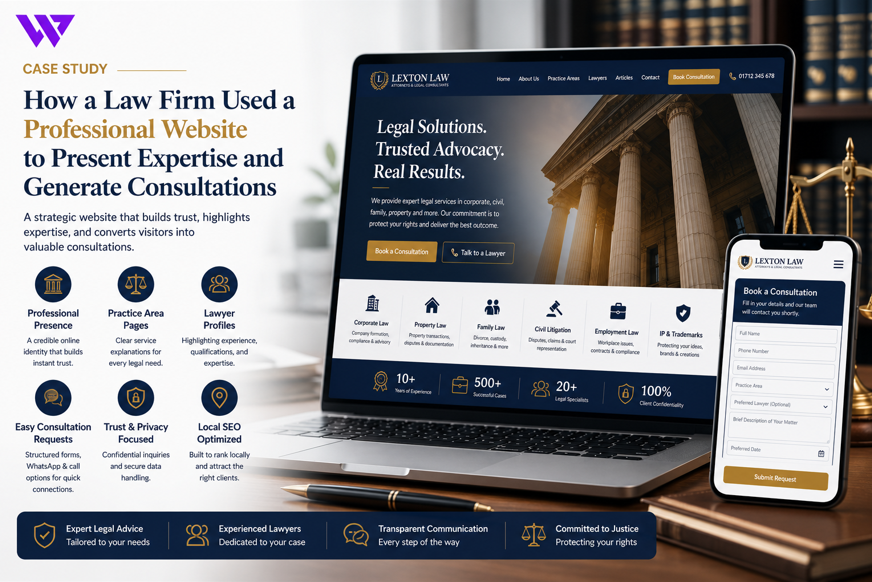
A growing law firm needed a professional website that could present its legal expertise clearly, build confidence with potential clients, and generate structured consultation requests.
The firm provided legal services for individuals, families, businesses, property owners, employers, and organizations. Its practice areas included corporate law, property matters, family law, civil disputes, employment issues, contract review, intellectual property, and other legal services.
Before the website project, most inquiries arrived through referrals, phone calls, Facebook messages, WhatsApp, and personal networks.
Potential clients frequently asked:
- Does the firm handle my type of legal matter?
- Which lawyer should I contact?
- What information is required for a consultation?
- Where is the office located?
- Can I request an online consultation?
- What documents should I prepare?
- How does the consultation process work?
- Is my information kept private?
- How can I schedule a meeting?
The existing online presence did not answer these questions consistently.
Webnion planned a responsive, professional law firm website focused on practice-area pages, lawyer profiles, credibility, structured consultation requests, privacy-conscious communication, and local search visibility.
The goal was to help potential clients understand the firm’s services and take an appropriate next step without making unrealistic promises about legal outcomes.
2. The Business Challenge
Legal clients usually arrive with uncertainty, urgency, or concern.
They may be dealing with:
- A business dispute
- A family-related matter
- A property transaction
- A contract problem
- An employment issue
- A legal notice
- A compliance requirement
- An intellectual property concern
- A court-related matter
- A need for professional legal advice
A generic website with only a firm name, phone number, and service list could not build enough confidence.
The firm faced several common challenges:
- Practice areas were not explained clearly
- Lawyer expertise was difficult to evaluate
- Potential clients did not know which service applied to their matter
- Consultation inquiries arrived without useful details
- The website lacked professional credibility
- Office location and contact information were difficult to find
- Mobile visitors faced long and complicated pages
- Legal articles were disconnected from service pages
- Testimonials were not presented responsibly
- There was no clear consultation journey
- The website lacked local SEO structure
- Visitors sometimes expected immediate legal advice through ordinary contact forms
The firm needed a website that balanced professional presentation, helpful information, confidentiality, and clear action.
3. Project Objectives
The project was planned around the following objectives:
- Present the law firm professionally
- Explain practice areas in clear language
- Highlight verified lawyer experience
- Build credibility without exaggerated claims
- Make consultation requests easier
- Collect useful inquiry information
- Support phone, WhatsApp, and online consultation requests
- Improve mobile usability
- Communicate office location and hours clearly
- Protect confidential information
- Support legal articles and educational content
- Strengthen local search foundations
- Create a scalable structure for future lawyers and services
Every section was designed to help visitors understand the firm and request a consultation responsibly.
4. Our Strategy
We planned the website around the questions potential clients ask before contacting a lawyer:
Does the firm handle this type of matter?
Who will review my situation?
What information should I prepare?
How can I request a consultation?
What happens after I submit the request?
The intended journey was:
Search for legal help → Open a relevant practice-area page → Review the firm’s expertise → Explore lawyer profiles → Understand the consultation process → Submit a request or call the office
The website provided general legal information but did not attempt to provide personalized legal advice before a formal consultation.
This created a professional and responsible client-acquisition journey.
5. Professional Website Positioning
A law firm website needs to communicate credibility immediately.
The website design focused on:
- Professional typography
- Clean layouts
- Strong content hierarchy
- Real lawyer and office photography
- Consistent branding
- Calm, confident colors
- Clear contact details
- Easy-to-find consultation actions
- Responsible legal disclaimers
- Mobile accessibility
The visual direction avoided aggressive sales graphics, exaggerated badges, and unsupported claims.
The website positioned the firm as organized, experienced, accessible, and professional.
6. Practice-Area Organization
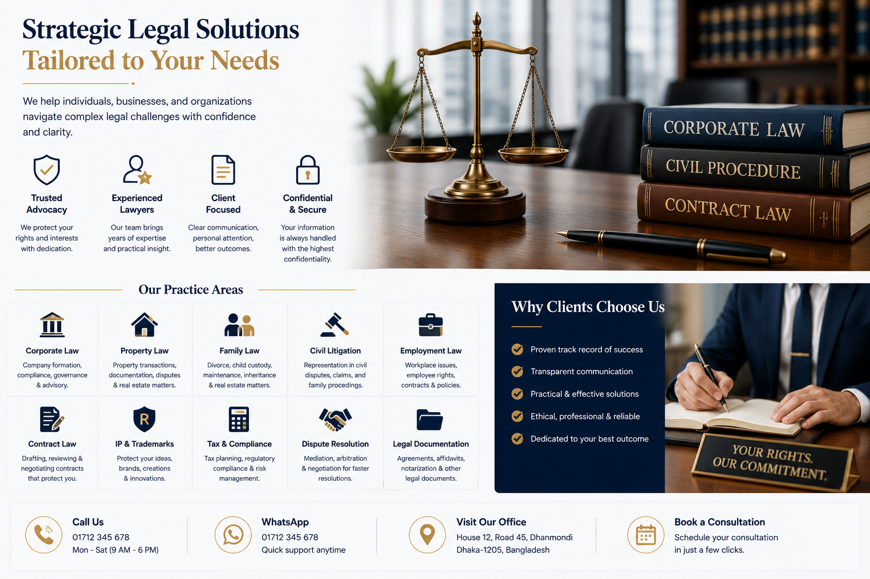
The firm’s legal services were divided into clear practice areas.
Depending on the firm’s actual services, these could include:
- Corporate and Commercial Law
- Company Formation
- Contract Drafting and Review
- Property and Real Estate Law
- Family Law
- Civil Litigation
- Employment and Labour Matters
- Intellectual Property
- Tax and Regulatory Matters
- Banking and Finance
- Legal Documentation
- Dispute Resolution
- Arbitration and Mediation
- Immigration Services
- Criminal Defence where applicable
Each practice area received its own dedicated page.
This helped visitors reach relevant information without reading one long and confusing service list.
7. Patient-Friendly Legal Language
Legal topics can be difficult for ordinary clients to understand.
The website avoided unnecessary legal jargon and explained services through practical language.
Instead of only saying:
“Commercial dispute resolution and litigation”
The page could explain:
“We assist businesses with contract disputes, unpaid obligations, partnership conflicts, and other commercial disagreements through negotiation, mediation, arbitration, or court proceedings where appropriate.”
This helped visitors understand whether the service might be relevant to their situation.
Detailed legal analysis remained part of the formal consultation process.
8. Corporate and Commercial Law Page
The corporate law page could explain services such as:
- Company formation
- Shareholder agreements
- Partnership agreements
- Commercial contracts
- Corporate governance
- Regulatory compliance
- Business restructuring
- Legal due diligence
- Corporate disputes
- Ongoing legal advisory services
The page focused on business needs and decision-making.
It did not promise that legal documentation would eliminate every future dispute or business risk.
9. Contract Drafting and Review Page
Contracts are important for businesses, employers, property owners, service providers, and individuals.
The service page could explain support for:
- Service agreements
- Employment contracts
- Vendor agreements
- Partnership agreements
- Non-disclosure agreements
- Terms and conditions
- Purchase agreements
- Lease agreements
- Commercial contracts
- Contract review and risk identification
The website clarified that contract requirements depend on the specific transaction, parties, jurisdiction, and business context.
A consultation request helped the firm collect the information needed for review.
10. Property and Real Estate Law Page
The property-law page could present services related to:
- Property purchase and sale
- Title and ownership review
- Lease agreements
- Land documentation
- Property disputes
- Developer and buyer agreements
- Legal due diligence
- Registration support
- Inheritance-related property matters
- Commercial property transactions
The page encouraged clients to provide relevant documents during consultation.
It avoided giving a final opinion on ownership, title, or transaction safety without reviewing the records.
11. Family Law Page
Family-related legal matters require sensitive communication.
The page could explain services such as:
- Divorce consultation
- Child custody matters
- Maintenance and financial support
- Marriage-related documentation
- Guardianship
- Family settlements
- Inheritance matters
- Mediation
- Domestic legal concerns
The content remained respectful and confidential.
The website avoided dramatic language or promises about case outcomes.
Potential clients were encouraged to request a private consultation.
12. Civil Litigation and Dispute Resolution
The dispute-resolution page could explain the firm’s support for:
- Contract disputes
- Property disputes
- Financial claims
- Business conflicts
- Injunction-related matters
- Recovery claims
- Civil proceedings
- Negotiation
- Mediation
- Arbitration
- Court representation where applicable
The page clarified that the appropriate legal strategy depends on facts, documents, evidence, deadlines, and applicable law.
No outcome was guaranteed.
13. Employment and Labour Matters
The employment page could serve both employers and employees.
Services might include:
- Employment contracts
- Workplace policies
- Termination disputes
- Employee claims
- Disciplinary procedures
- Compensation matters
- Confidentiality agreements
- Workplace investigations
- Compliance guidance
- Employment-related dispute resolution
The website presented general information without replacing advice based on the specific employment relationship.
14. Intellectual Property Services
The intellectual property page could include:
- Trademark applications
- Copyright-related matters
- Brand protection
- Licensing agreements
- Intellectual property contracts
- Infringement concerns
- Ownership disputes
- Portfolio management
- Cease-and-desist communications
- Commercial use agreements
The page explained that registration, protection, enforcement, and availability depend on the relevant legal system and the specific intellectual property involved.
15. Lawyer Profile Pages
Each lawyer received a structured professional profile.
A profile could include:
- Lawyer’s name
- Professional title
- Verified qualifications
- Bar or professional membership where appropriate
- Practice areas
- Years of experience where verified
- Languages spoken
- Professional background
- Publications
- Consultation availability
- Contact or booking action
Only verified credentials and experience were displayed.
The website avoided unsupported labels such as “best lawyer,” “top attorney,” or “guaranteed expert.”
16. Presenting Expertise Responsibly
Legal expertise was presented through evidence rather than promotional exaggeration.
The website could show:
- Verified qualifications
- Professional memberships
- Practice-area experience
- Publications
- Speaking engagements
- Training
- Industry involvement
- Representative matter types
- Professional awards where verified
Confidential client information and case details were not published without permission.
The website did not imply that experience in one matter guaranteed the same result in another.
17. Lawyer and Practice-Area Connection
Each lawyer profile could link to the practice areas they handled.
Each practice-area page could also display relevant lawyers.
For example:
A visitor reading about corporate law could immediately view the profiles of lawyers working in corporate and commercial matters.
This created a more natural journey from service understanding to lawyer selection.
18. Professional About Page
The About page helped potential clients understand the firm’s identity.
It could include:
- Firm background
- Mission
- Values
- Areas of focus
- Client-service approach
- Professional standards
- Team
- Office information
- Consultation philosophy
- Community or industry involvement
The page avoided vague statements that could not be supported.
It focused on how the firm worked with clients and managed legal matters professionally.
19. Real Office and Team Photography
Professional photography helped strengthen credibility.
The website could include:
- Lawyer portraits
- Team photographs
- Office exterior
- Reception area
- Meeting rooms
- Work environment
- Library or research area
- Building entrance
- Parking or accessibility information
Real photography helped potential clients recognize the office before their first visit.
Confidential documents, client meetings, and private information were not shown.
20. Clear Consultation Calls to Action
The website used specific action labels such as:
- Request a Consultation
- Schedule a Meeting
- Call the Law Firm
- Ask About This Service
- Book an Online Consultation
- View Lawyer Profile
- Get Directions
Generic buttons such as “Learn More” were avoided where a clearer action was possible.
Calls to action remained professional and did not pressure visitors.
21. Consultation Request Form
The consultation form collected only the information needed for initial review.
Fields could include:
- Full name
- Phone number
- Email address
- Practice area
- Preferred lawyer
- Preferred consultation type
- Preferred date
- Preferred time
- Brief description
- How the client found the firm
- Consent confirmation
The form advised clients not to submit highly confidential, sensitive, or time-critical information before the firm confirmed representation.
22. Consultation Request Versus Legal Representation
The website clearly explained that submitting a form did not automatically create a lawyer-client relationship.
A confirmation message could state:
“Your consultation request has been received. Submission of this form does not create a lawyer-client relationship. The firm will review the request and contact you regarding availability and the next steps.”
This helped manage expectations and protected both the potential client and the firm.
23. Conflict-Check Awareness
Law firms may need to complete a conflict check before accepting a matter.
The website could explain that the firm might request:
- Names of involved parties
- Company names
- Opposing parties
- Relevant organizations
- Basic matter description
Potential clients were advised not to send detailed confidential information until the firm confirmed that it could discuss or accept the matter.
This was an important part of responsible legal intake.
24. Document Uploads
Where the firm had a secure process, the consultation form could support document uploads.
Potential files might include:
- Contracts
- Legal notices
- Property documents
- Court documents
- Correspondence
- Company records
- Relevant agreements
The website could define:
- Allowed file formats
- Maximum file size
- Purpose of the upload
- Who could access the file
- How long it might be retained
Sensitive documents required secure handling and restricted access.
25. WhatsApp-Assisted Consultation Requests
Some potential clients preferred WhatsApp.
A prepared message could include:
Hello, I would like to request a legal consultation.
Practice Area: Property Law
Preferred Consultation: In person
Preferred Date:
Full Name:
Service Page: [link]
Please confirm availability and the next steps.
The website advised users not to send confidential evidence or detailed case information through unsecured messaging before receiving instructions from the firm.
26. Click-to-Call Support
Some legal concerns require direct communication.
A visible click-to-call action could appear:
- In the header
- On practice-area pages
- On lawyer profiles
- In the mobile sticky bar
- Near office hours
- On the contact page
This helped potential clients who preferred speaking with the firm before completing a form.
The website did not imply that immediate legal advice was always available by phone.
27. Online Consultation Support
Where the firm offered remote consultations, the website could explain:
- Available consultation platforms
- Appointment process
- Identity verification
- Consultation fee
- Required documents
- Payment method
- Meeting-link delivery
- Rescheduling policy
- Limitations of online consultation
The firm remained responsible for deciding whether a matter required an in-person meeting.
28. Consultation Fees
Where approved by the firm, the website could communicate:
- Initial consultation fee
- Free preliminary call availability
- Document-review fee
- Online consultation fee
- Payment timing
- Cancellation policy
- Rescheduling conditions
The website avoided presenting every legal matter as having one fixed total cost.
Legal fees may depend on complexity, time, scope, urgency, evidence, proceedings, and required professional work.
29. Clear Office Information
The contact section could display:
- Office address
- Map
- Landmark
- Building and floor
- Phone number
- Email address
- WhatsApp number
- Office hours
- Parking information
- Accessibility guidance
- Get Directions action
Mobile users could open the location directly in a map application.
Clear information reduced repetitive direction calls and missed meetings.
30. Office Hours and Availability
The website could display:
- Regular office hours
- Consultation hours
- Weekly closing day
- Holiday schedule
- Remote consultation availability
- Last appointment time
Temporary announcements could be added for:
- Public holidays
- Lawyer leave
- Office closure
- Schedule changes
- Court commitments
- Maintenance
This helped clients understand when the firm could review or confirm requests.
31. Legal Articles and Educational Content
The law firm could publish articles that explained general legal topics.
Examples included:
- What to review before signing a contract
- Common legal considerations when buying property
- Why businesses need written agreements
- Questions to ask during a legal consultation
- How to prepare documents for a lawyer
- Understanding dispute-resolution options
- Legal considerations when starting a company
- Basic intellectual property protection for brands
Articles were educational and general.
They did not provide personalized legal advice or guarantee that the information applied to every situation.
32. Connecting Articles to Practice Areas
Legal articles were linked to relevant service pages.
For example:
- A contract article could link to contract-review services
- A property guide could link to property-law consultation
- A company-formation article could link to corporate services
- An employment article could link to labour-law support
This helped readers move from general education to an appropriate consultation request.
It also created a stronger internal-linking structure for SEO.
33. Search Engine Optimization Structure
The website supported SEO through clear practice-area, lawyer, location, and educational pages.
Potential search-focused pages could include:
- Law firm in the target city
- Corporate lawyer
- Property lawyer
- Contract lawyer
- Family law consultation
- Civil litigation lawyer
- Employment lawyer
- Trademark lawyer
- Legal consultation
- Business legal services
Each page included useful and specific content instead of repeating keywords unnaturally.
SEO created a stronger discovery foundation but did not guarantee rankings or new clients.
34. Local SEO for the Law Firm
Local SEO focused on helping nearby potential clients find the office.
The website could include:
- Consistent business name
- Accurate address
- Phone number
- Map
- Office hours
- Location-specific service pages
- Lawyer profiles
- Consultation link
- Local business information
- Clear contact details
This information needed to remain consistent across the website and public business listings.
35. Location-Based Practice Pages
Where the firm served several areas, useful location-based pages could be created.
Examples included:
- Corporate law firm in Dhaka
- Property lawyer in Dhanmondi
- Contract lawyer in Gulshan
- Family law consultation in Uttara
- Business lawyer in Banani
Each page needed genuinely useful location and service information.
The website avoided duplicating the same content with only the location name changed.
36. Client Testimonials
Client testimonials could strengthen trust when used responsibly.
Testimonials could discuss:
- Professional communication
- Consultation experience
- Responsiveness
- Document preparation
- Clarity of explanation
- General service quality
The website did not publish confidential case details without permission.
Testimonials were presented as individual experiences and not as guarantees of future results.
37. Legal Results and Case Examples
Where professional and ethical rules allowed, the firm could publish carefully anonymized matter examples.
A case example could include:
- General legal issue
- Type of service provided
- Process followed
- Important challenge
- General resolution approach
The website avoided revealing confidential information.
It also included a disclaimer that past results do not guarantee similar outcomes in future matters.
38. Professional Reviews
Reviews could be collected from:
- Website testimonial forms
- Public business profiles
- Approved follow-up requests
- Professional directories
The source could be identified where appropriate.
The firm needed permission before publishing a client’s full name, company, photograph, or legal matter details.
39. Frequently Asked Questions
The website could answer common questions such as:
- How do I request a consultation?
- Does submitting the form create a lawyer-client relationship?
- What documents should I prepare?
- Can I choose a specific lawyer?
- Is an online consultation available?
- How are legal fees determined?
- Can I upload documents?
- How quickly will the firm respond?
- Is my information confidential?
- What happens if the firm cannot accept my matter?
This reduced repetitive inquiries while helping potential clients understand the process.
40. Legal Disclaimer
The website included a clear disclaimer explaining that:
- Website content was general information
- It was not legal advice
- Viewing the website did not create a lawyer-client relationship
- Outcomes depend on individual circumstances
- Laws and procedures may change
- A formal consultation was required for advice
- Past results did not guarantee future results
The disclaimer remained accessible without interrupting the main user journey.
41. Privacy and Confidentiality
Legal inquiries can contain sensitive information.
The website needed clear privacy practices explaining:
- What information was collected
- Why it was collected
- Who could access it
- How it was stored
- How long it might be retained
- Which third-party tools were used
- How users could request correction or deletion
- How document uploads were handled
Access to consultation requests was limited to authorized staff.
42. Secure Form Handling
The consultation system could include:
- Encrypted website connection
- CSRF protection
- Input validation
- Spam prevention
- Secure file uploads
- Restricted administrator access
- Strong password requirements
- Activity logging
- Scheduled backups
- Controlled data export
No website can promise absolute security.
Appropriate technical and operational safeguards helped reduce avoidable risk.
43. Accessibility Considerations
The law firm website needed to remain usable for different visitors.
The design considered:
- Readable font sizes
- Strong contrast
- Clear form labels
- Keyboard navigation
- Large touch targets
- Descriptive buttons
- Alternative text
- Simple menus
- Clear error messages
- Structured headings
Important legal and contact information was not placed only inside images.
44. Mobile Performance
Potential clients often search for legal help from mobile devices.
The website was planned with attention to:
- Optimized images
- Responsive image sizes
- Lazy loading
- Reduced unnecessary scripts
- Efficient font loading
- Clean front-end code
- Browser caching
- Lightweight forms
Faster loading helped visitors reach practice areas and consultation actions quickly.
45. Consultation Administration
Authorized staff could review consultation requests through an organized dashboard.
Records could include:
- Potential client name
- Phone number
- Email address
- Practice area
- Preferred lawyer
- Preferred meeting type
- Preferred date
- Inquiry source
- Conflict-check status
- Consultation status
- Staff notes
Statuses could include:
- New Inquiry
- Initial Review
- Conflict Check Required
- Contacted
- Consultation Scheduled
- Waiting for Documents
- Accepted
- Declined
- Completed
This reduced reliance on spreadsheets, notebooks, and scattered messages.
46. Staff Roles and Permissions
Different firm members required different access levels.
Roles could include:
- Administrator
- Managing Partner
- Lawyer
- Consultation Coordinator
- Legal Assistant
- Content Manager
A content manager could update articles without accessing confidential consultation records.
A lawyer could view only the matters or requests assigned to them.
Role-based access reduced unnecessary exposure of sensitive information.
47. Consultation Notifications
The system could notify authorized staff when a new request was submitted.
Notifications could be sent through:
- Administration dashboard
- Approved internal messaging
- SMS where appropriate
Potential clients could receive a confirmation that the request was received.
The message clarified that the consultation was not confirmed until the firm responded.
48. Analytics and Consultation Tracking
The website could track meaningful actions such as:
- Practice-area visits
- Lawyer-profile views
- Consultation submissions
- Phone clicks
- WhatsApp clicks
- Direction clicks
- Article views
- Document-download interactions
- FAQ openings
This helped the firm understand which services and content generated interest.
No unverified consultation-growth, revenue, ranking, or case-result claims were made.
49. Design Approach
The visual direction focused on authority, clarity, trust, confidentiality, and accessibility.
The design system included:
- Clean professional layouts
- Strong but restrained typography
- Real lawyer photography
- Consistent practice-area cards
- Structured lawyer profiles
- Visible consultation actions
- Calm brand colors
- Clear contact information
- Mobile-friendly forms
- Responsible disclaimers
The website avoided excessive legal imagery, intimidating visuals, and aggressive sales language.
Professional trust remained the main focus.
50. Key Features Delivered
The law firm website solution included:
- Responsive professional website design
- Mobile-first navigation
- Organized practice-area pages
- Clear legal service explanations
- Lawyer profile pages
- Real office and team photography
- Structured consultation forms
- Conflict-check awareness
- Secure document uploads where supported
- WhatsApp-assisted consultation requests
- Click-to-call support
- Online consultation information
- Office maps and directions
- Consultation fee guidance
- Legal articles and educational content
- Internal linking
- Client testimonials
- Responsible case examples
- Legal disclaimer
- Privacy-conscious forms
- Secure form handling
- Accessibility improvements
- Local SEO structure
- Location-focused service pages
- Consultation administration
- Staff roles and permissions
- Notifications
- Analytics and consultation tracking
- Scalable lawyer and service management
Each feature was selected to improve professional credibility, consultation quality, client access, and internal organization.
51. The Outcome
The completed solution created a more professional and structured online presence for the law firm.
Potential clients could explore practice areas, review lawyer profiles, read general legal information, understand the consultation process, find the office, and submit a structured request.
The firm gained a clearer system for presenting expertise, managing inquiries, conducting initial reviews, and publishing educational content.
No unverified consultation, revenue, ranking, or case-success percentages are being claimed. However, the website directly addressed several credibility, communication, and usability barriers that previously made client acquisition more difficult.
52. Business Value Created
The website helps the law firm:
- Present its expertise professionally
- Make legal services easier to understand
- Build credibility through verified lawyer profiles
- Generate more structured consultation inquiries
- Reduce repetitive administrative questions
- Improve mobile access
- Clarify consultation expectations
- Support conflict-check procedures
- Protect confidential information
- Strengthen local search foundations
- Connect legal articles with services
- Manage consultations more clearly
- Track meaningful visitor actions
- Add future lawyers and practice areas more easily
The project demonstrates that a professional law firm website should combine expertise, trust, education, confidentiality, and clear consultation actions.
53. Why This Project Matters
Potential clients rarely choose a law firm based only on a logo or a list of services.
They want to understand:
- Whether the firm handles their type of matter
- Which lawyer may be relevant
- How the consultation process works
- What information is required
- Where the firm is located
- Whether their information will be treated responsibly
- What happens after they submit an inquiry
A strong law firm website connects:
Search visibility → Practice-area information → Lawyer credibility → Educational content → Consultation request → Initial review
The website becomes a professional digital reception and client-intake platform.
It helps potential clients take an informed first step without promising legal advice or a particular outcome.
54. Frequently Asked Questions
Why does a law firm need separate practice-area pages?
Separate pages help visitors understand specific services and create stronger search visibility for relevant legal topics.
Can potential clients request consultations from mobile phones?
Yes. Practice areas, lawyer profiles, forms, calls, WhatsApp, and directions can be optimized for mobile devices.
Does submitting a form create a lawyer-client relationship?
No. The website should clearly explain that representation begins only after the firm completes its review and confirms the engagement.
Can clients choose a specific lawyer?
Yes. Lawyer profiles and availability can help potential clients request a preferred professional.
Can documents be uploaded through the website?
Yes, where the firm has a secure and approved document-upload process.
Can the website display legal fees?
Consultation fees or starting prices may be displayed where appropriate. Final legal fees usually depend on the matter’s scope and complexity.
Can consultations be held online?
Yes, where the firm supports remote consultations and the matter is suitable for that format.
Can testimonials be published?
Yes, with appropriate permission and without revealing confidential information or guaranteeing similar outcomes.
Can the website help with local SEO?
Yes. Practice-area pages, lawyer profiles, location information, articles, internal links, and consistent business details create a stronger local search foundation.
Does the website provide legal advice?
No. Website content is general information. Legal advice requires review of the specific facts and a formal consultation with a qualified lawyer.
55. Need a Professional Website for Your Law Firm?
A law firm website should do more than list services and contact details.
It should help potential clients understand the firm’s expertise, evaluate professional credibility, and request a consultation through a clear and responsible process.
Webnion designs and develops responsive websites for:
- Law firms
- Independent lawyers
- Corporate legal practices
- Property law firms
- Family law practices
- Litigation teams
- Legal consultants
- Multi-office professional firms
We create professional digital platforms that combine practice-area pages, lawyer profiles, educational content, consultation requests, privacy-conscious forms, and local SEO foundations.
Build a law firm website that presents your expertise clearly and turns qualified interest into organized consultation opportunities